

🔬 Research Spotlight: MOTS-c & PCOS — What New Human Research Found
Could Mitochondrial Signaling Be Connected to PCOS?
A new 2026 human study is bringing attention to an interesting connection between MOTS-c, mitochondrial function, and polycystic ovary syndrome (PCOS).
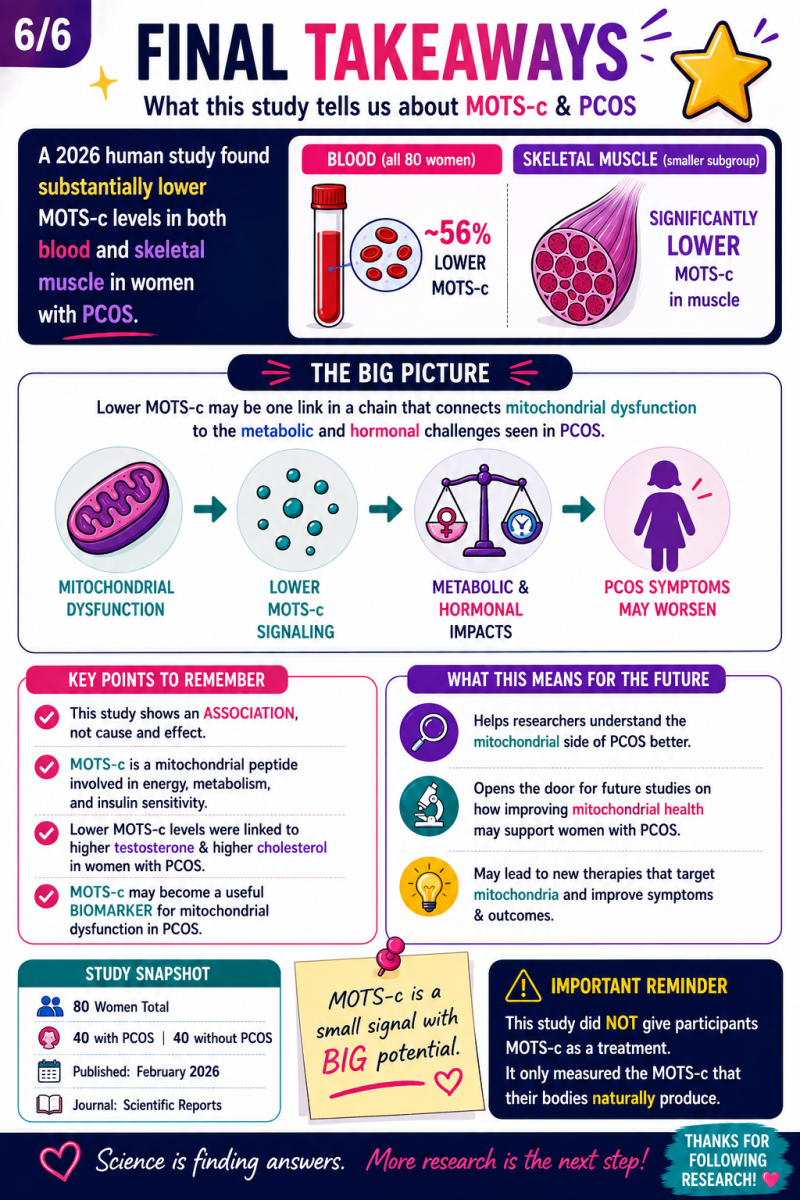
Researchers discovered that women with PCOS had significantly lower levels of naturally occurring MOTS-c in both their blood and skeletal muscle compared with women without PCOS.
But what does that actually mean?
Let's break down the research in simple terms.
🧬 First — What Is MOTS-c?
MOTS-c is a small mitochondrial-derived peptide.
Mitochondria are commonly called the "powerhouses of the cell" because they help cells produce usable energy.
But mitochondria do much more than simply make energy.
They also participate in:
-
Metabolism
-
Glucose regulation
-
Cellular signaling
-
Responses to cellular stress
-
Energy balance
MOTS-c is one of the signaling molecules being investigated for its involvement in these processes.
You can think of MOTS-c as one of the messages associated with the cell's energy system, helping coordinate how cells respond to metabolic demands.
🔎 Why Did Researchers Look at PCOS?
PCOS is a complex endocrine and metabolic condition.
Researchers have become increasingly interested in the role that mitochondrial function and metabolic signaling may play in PCOS.
Because MOTS-c has been associated with glucose regulation and skeletal-muscle metabolism, researchers wanted to answer an important question:
Do women with PCOS have different levels of MOTS-c than women without PCOS?
👩🔬 The Study
Researchers studied 80 women.
40 Women With PCOS
compared with
40 Women Without PCOS
The groups were matched for age and BMI, helping researchers make a more appropriate comparison between them.
Researchers then measured MOTS-c in two places:
🩸 Blood
Serum MOTS-c concentrations were measured in all 80 women.
💪 Skeletal Muscle
Researchers also examined MOTS-c expression directly within skeletal-muscle samples from a smaller subgroup.
This allowed researchers to look at MOTS-c both circulating in the body and within metabolically active tissue.
📊 What Did They Find?
This is where the results became particularly interesting.
MOTS-c Was Much Lower in the Blood
Average circulating MOTS-c levels were approximately:
Women Without PCOS
498 pg/mL
Women With PCOS
220 pg/mL
That means circulating MOTS-c was approximately 56% lower in the PCOS group.
💪 MOTS-c Was Also Lower in Skeletal Muscle
Researchers observed a similar pattern when they examined skeletal muscle.
MOTS-c expression was approximately:
Women Without PCOS
100 units
Women With PCOS
74 units
The researchers therefore weren't seeing a difference only in the bloodstream.
Reduced MOTS-c was also observed directly within skeletal muscle.
⚡ Why Is Skeletal Muscle Important?
Skeletal muscle isn't only responsible for movement.
It is also an extremely important metabolic tissue.
Skeletal muscle participates in:
-
Glucose utilization
-
Energy expenditure
-
Insulin-related signaling
-
Mitochondrial activity
-
Overall metabolic regulation
Finding lower MOTS-c within skeletal muscle therefore gives researchers another clue that mitochondrial signaling may be altered in PCOS.
🧪 Researchers Found Another Interesting Connection
Lower circulating MOTS-c levels were also associated with:
⬆️ Higher Total Testosterone
and
⬆️ Higher Total Cholesterol
Both hormonal and metabolic abnormalities can occur in PCOS.
This raises an interesting research question:
Could altered mitochondrial signaling be connected with some of the endocrine and metabolic characteristics observed in PCOS?
At this point, researchers don't know the complete answer.
But these findings give scientists another pathway to investigate.
🔋 Think of It Like a Cellular Communication System
Here's one simple way to picture the research.
Imagine mitochondria as tiny power plants inside our cells.
Those power plants don't simply produce energy—they also communicate with the rest of the cell.
MOTS-c can be thought of as one of the signals associated with that mitochondrial communication system.
The study found:
PCOS
↓
Lower naturally occurring MOTS-c
↓
Less MOTS-c signaling detected in blood and skeletal muscle
↓
Possible connection with altered mitochondrial and metabolic function
Researchers are now trying to understand exactly what that relationship means.
🔬 Could MOTS-c Become a Biomarker?
Possibly.
A biomarker is something measurable that researchers can use as an indicator of a biological process or condition.
The researchers suggest that MOTS-c may potentially serve as a marker of tissue-specific mitochondrial involvement in PCOS.
That doesn't mean MOTS-c is currently a diagnostic test for PCOS.
Instead, it means researchers have identified something measurable that could help scientists better understand the mitochondrial component of PCOS in future studies.
⚠️ What This Study Does NOT Tell Us
This distinction is extremely important.
The researchers did NOT give participants MOTS-c.
They measured the MOTS-c that the women's bodies naturally produced.
Therefore, this study does NOT demonstrate that administering MOTS-c:
-
Treats PCOS
-
Improves PCOS symptoms
-
Lowers testosterone
-
Lowers cholesterol
-
Improves fertility
-
Corrects insulin resistance
The study identified an association.
It did not establish cause and effect.
🔗 Association ≠ Causation
Researchers found that PCOS and lower MOTS-c occurred together.
That doesn't yet tell us:
Does PCOS cause MOTS-c to decrease?
Does reduced MOTS-c contribute to PCOS?
Does mitochondrial dysfunction influence both?
Or are several biological mechanisms involved?
Those questions require additional research.
This is a perfect example of why association does not automatically equal causation.
⭐ The Big Takeaway
This 2026 human study found that women with PCOS had substantially lower naturally occurring MOTS-c in both their blood and skeletal muscle compared with women without PCOS.
Researchers also observed relationships between lower MOTS-c and higher testosterone and total cholesterol.
Together, the findings strengthen scientific interest in the possible connection between:
Mitochondria → MOTS-c signaling → Metabolism → Endocrine function → PCOS
MOTS-c may eventually help researchers better understand mitochondrial dysfunction associated with PCOS.
But this research is still developing.
One study gives us an important clue — not the final answer.
📚 Study Information
Study: Reduced serum and skeletal muscle MOTS-c levels in women with polycystic ovary syndrome are associated with mitochondrial dysfunction
Journal: Scientific Reports
Published: February 12, 2026
Participants: 80 women — 40 with PCOS and 40 age- and BMI-matched controls
PMID: 41680431
DOI: 10.1038/s41598-026-39687-x
Read the original study:
https://pubmed.ncbi.nlm.nih.gov/41680431/
The ResearchPeps Journal
Independent Educational Research & Scientific Information
The ResearchPeps Journal provides educational information about research compounds, peptides, laboratory testing, cellular biology, metabolism, mitochondrial science, and emerging scientific research.
Looking for ResearchPeps?
Visit ResearchPeps.org to learn more about ResearchPeps and view its available research products.
ResearchPeps Website:
https://researchpeps.org
Educational & Research Disclaimer
Content provided by The ResearchPeps Journal is for educational and informational purposes only. Information presented on this website is intended to discuss scientific literature, laboratory research, research compounds, and related scientific concepts.
Content should not be interpreted as medical advice, diagnosis, treatment guidance, or a recommendation for human use. Discussion of a compound or research finding does not establish its safety, effectiveness, or suitability for any particular purpose.
Research compounds discussed within the Journal may be investigational and may not be approved by the U.S. Food and Drug Administration (FDA) for human use.
Always refer to the original scientific publication when evaluating research findings.