⚡ Understanding Cellular Energy: How Cells Produce and Use Energy
Category: Cellular & Mitochondrial Research
Reading Time: 7–8 minutes
Published: August 21 2026
Introduction
Every cell requires energy to function. From repairing DNA and building proteins to transporting molecules and maintaining cell membranes, cellular activity depends on a continuous supply of usable energy.
Much of this energy is supplied through a molecule called ATP (adenosine triphosphate).
Understanding how cells produce ATP—and why mitochondria are so important to this process—is fundamental to cellular and mitochondrial research.
🔋 What Is Cellular Energy?
Food contains chemical energy, but cells cannot directly use most of that energy in its original form.
Instead, nutrients such as carbohydrates and fats are broken down through a series of metabolic reactions. The energy released during these reactions can then be captured and used to produce ATP.
Cells use ATP to power processes including:
- Muscle contraction
- Protein production
- Cellular transport
- DNA replication and repair
- Cell signaling
- Maintenance of ion gradients
- Growth and cellular maintenance
ATP is often described as the cell's "energy currency."
⚡ What Is ATP?
ATP stands for Adenosine Triphosphate.
ATP contains three phosphate groups. When cells remove one of these phosphate groups, ATP becomes ADP (adenosine diphosphate) and usable energy can be released for cellular processes.
A simplified way to picture the cycle is:
Nutrients → Cellular Metabolism → ATP → Cellular Work
Cells continually produce and use ATP throughout their lifetime.
🫘 The Mitochondria Connection
Mitochondria are specialized structures found inside most human cells.
They're often called the "powerhouses of the cell" because they generate much of the ATP required for cellular activity.
But mitochondria do considerably more than produce energy.
Researchers study mitochondria because they're also involved in:
- Metabolism
- Calcium signaling
- Reactive oxygen species (ROS) regulation
- Cellular stress responses
- Programmed cell death
- Cellular communication
This makes mitochondria central to many areas of modern biological research.
🧬 How Do Mitochondria Produce Energy?
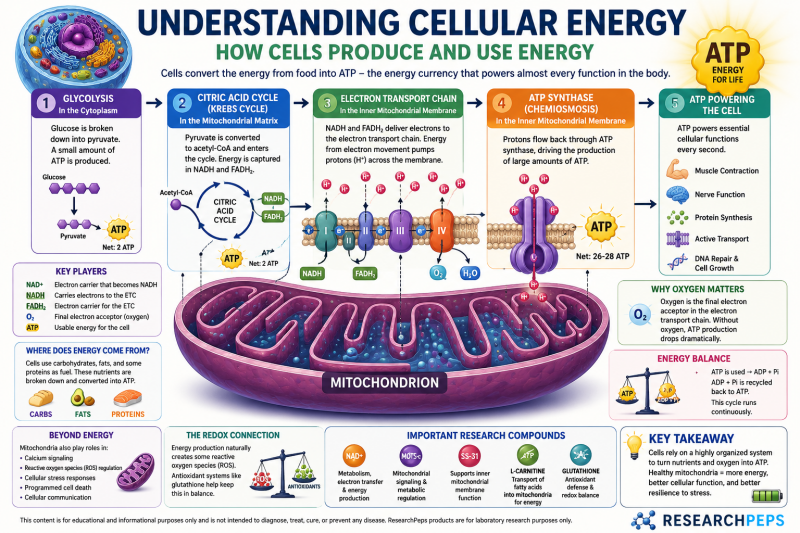
Cellular energy production occurs through several interconnected processes.
1. Glycolysis
Energy production begins with glycolysis, which occurs primarily in the cytoplasm rather than inside mitochondria.
During glycolysis, glucose is broken into smaller molecules.
This process produces a relatively small amount of ATP while also generating molecules that can carry high-energy electrons into later metabolic pathways.
2. The Citric Acid Cycle
Inside mitochondria, molecules derived from carbohydrates, fats, and some amino acids can enter the citric acid cycle, also known as the Krebs cycle or TCA cycle.
Rather than simply producing large amounts of ATP directly, this cycle captures energy in electron-carrying molecules, particularly:
- NADH
- FADH₂
These molecules deliver high-energy electrons to the next stage.
⚙️ The Electron Transport Chain
The electron transport chain (ETC) is located within the inner mitochondrial membrane.
Electrons carried by NADH and FADH₂ move through a series of protein complexes.
The energy released during this process is used to pump hydrogen ions (protons) across the mitochondrial membrane.
This creates a proton gradient—essentially stored potential energy across the membrane.
🔄 ATP Synthase: A Molecular Energy Generator
The accumulated protons eventually flow back across the mitochondrial membrane through a remarkable enzyme called ATP synthase.
ATP synthase uses the energy from this proton movement to produce ATP.
This overall process is known as oxidative phosphorylation.
A simplified version looks like:
Food → Nutrients → Electron Carriers → Electron Transport Chain → Proton Gradient → ATP Synthase → ATP
This highly organized system allows cells to efficiently convert chemical energy into a form they can use.
🧪 Why Is Oxygen Important?
Oxygen plays a critical role at the end of the electron transport chain.
It serves as the final electron acceptor, ultimately allowing electrons to continue moving through the system.
Without sufficient oxygen, oxidative phosphorylation cannot operate normally, and cells must rely more heavily on other methods of producing ATP.
🧬 NAD+ and Cellular Energy
NAD+ (nicotinamide adenine dinucleotide) is an essential coenzyme involved in cellular metabolism.
During metabolic reactions, NAD+ can accept electrons and become NADH.
NADH then transports those electrons to the mitochondrial electron transport chain.
This cycling between NAD+ and NADH is one reason NAD+ is such an important molecule in cellular energy research.
Researchers also investigate NAD+ in connection with:
- Mitochondrial metabolism
- DNA repair
- Redox reactions
- Sirtuin enzymes
- Cellular aging
🥑 What About Fats?
Glucose isn't the only source of cellular energy.
Fatty acids contain substantial amounts of stored chemical energy.
Before many fatty acids can be metabolized, they must reach the mitochondria. L-carnitine participates in transporting certain long-chain fatty acids into mitochondria.
Inside the mitochondria, fatty acids undergo beta-oxidation, generating molecules that can feed into energy-producing pathways.
This is why L-carnitine frequently appears in discussions of mitochondrial metabolism.
🔴 Cellular Energy & Reactive Oxygen Species
Mitochondrial energy production isn't perfectly efficient.
During electron transport, some electrons can react with oxygen and contribute to the formation of reactive oxygen species (ROS).
Small amounts of ROS participate in normal cellular signaling.
However, excessive ROS production relative to antioxidant defenses can contribute to oxidative stress.
This creates an important connection between:
Cellular Energy ↔ Mitochondrial Function ↔ ROS ↔ Oxidative Stress
🛡️ How Do Cells Protect Themselves?
Cells contain antioxidant systems that help regulate reactive molecules generated during metabolism.
Important systems include:
- Glutathione
- Superoxide dismutase (SOD)
- Catalase
- Glutathione peroxidase
The goal isn't necessarily to eliminate all ROS. Instead, cells maintain a controlled redox balance in which reactive molecules and antioxidant defenses remain appropriately regulated.
🔬 What Happens When Mitochondrial Function Changes?
Researchers study what happens when mitochondria become less efficient or their normal function is disrupted.
Changes in mitochondrial function can influence:
- ATP production
- Reactive oxygen species
- Cellular metabolism
- Calcium regulation
- Cellular signaling
- Stress responses
Mitochondrial dysfunction is therefore studied across many areas of biology, including metabolic, neurological, cardiovascular and aging research.
🧪 Compounds Studied in Cellular Energy Research
Several compounds in your Cellular & Mitochondrial Research Library relate to different parts of cellular energy biology.
Compound Primary Research Area
NAD+ Cellular metabolism, electron transfer & redox biology
MOTS-c Mitochondrial signaling & metabolic regulation
SS-31 Inner mitochondrial membrane & cardiolipin biology
L-Carnitine Fatty-acid transport & energy metabolism
Glutathione Antioxidant defense & cellular redox balance
Although these compounds may appear within the same research category, they do not perform the same biological function and should not be considered interchangeable.
💡 Did You Know?
A cell doesn't maintain one permanent supply of ATP.
ATP is continuously produced, used and regenerated as cells perform biological work.
This constant recycling allows cells to respond rapidly to changing energy requirements.
🔍 How Do Researchers Study Cellular Energy?
Scientists can examine cellular energy and mitochondrial function using measurements such as:
- ATP production
- Oxygen consumption
- Mitochondrial membrane potential
- Electron transport activity
- NAD+/NADH balance
- Reactive oxygen species production
- Metabolic enzyme activity
Researchers may also use specialized laboratory instruments to measure how quickly cells consume oxygen or produce energy under different experimental conditions.
Research Snapshot
Term Simple Meaning
ATP Main molecule cells use for immediate energy
ADP Molecule produced after ATP releases usable energy
Mitochondria Cellular structures responsible for much ATP production
Glycolysis Process that begins breaking down glucose
NAD+ Coenzyme involved in electron transfer and metabolism
Electron Transport Chain Mitochondrial system that transfers electrons
ATP Synthase Enzyme that uses a proton gradient to produce ATP
Oxidative Phosphorylation Major mitochondrial ATP-producing process
ROS Reactive oxygen-containing molecules produced during metabolism
Key Takeaways
- Cells require a continuous supply of energy to function.
- ATP is the primary immediate energy currency used by cells.
- Mitochondria produce much of this ATP through oxidative phosphorylation.
- NAD+ and NADH help transfer electrons during cellular metabolism.
- Oxygen is essential to normal mitochondrial electron transport.
- Fatty acids can also provide energy through mitochondrial metabolism.
- Energy production naturally produces some reactive oxygen species.
- Cellular energy, mitochondrial function and oxidative stress are closely interconnected.
📚 Continue Learning
- Understanding Oxidative Stress
- What Are Mitochondria?
- NAD+
- NAD+ vs Glutathione
- SS-31
- MOTS-c
- L-Carnitine + B12
- Glutathione
- Research Spotlight: SS-31 & Mitochondrial Function
- Glossary of Research Terms
Educational Notice
This article is intended solely for educational and informational purposes. It summarizes scientific terminology, biological mechanisms, and areas of published research. It does not establish the safety, effectiveness, identity, purity, or approved use of any particular research material. Nothing in this article should be interpreted as medical advice, treatment guidance, dosing information, or a recommendation for human or animal use. ResearchPeps products are offered strictly for laboratory research purposes.