Category: Cellular & Mitochondrial Research
Reading Time: 7–8 minutes
Posted: August 21 2026
⚡ Understanding Oxidative Stress: What Happens When Cellular Balance Is Disrupted
The term oxidative stress appears frequently in research involving mitochondria, cellular aging, antioxidants, inflammation, and metabolic health—but what does it actually mean?
Oxidation is a normal part of cellular biology. Every day, cells perform thousands of chemical reactions, including reactions required to convert nutrients into usable energy.
Some of these processes produce highly reactive molecules known as reactive oxygen species (ROS).
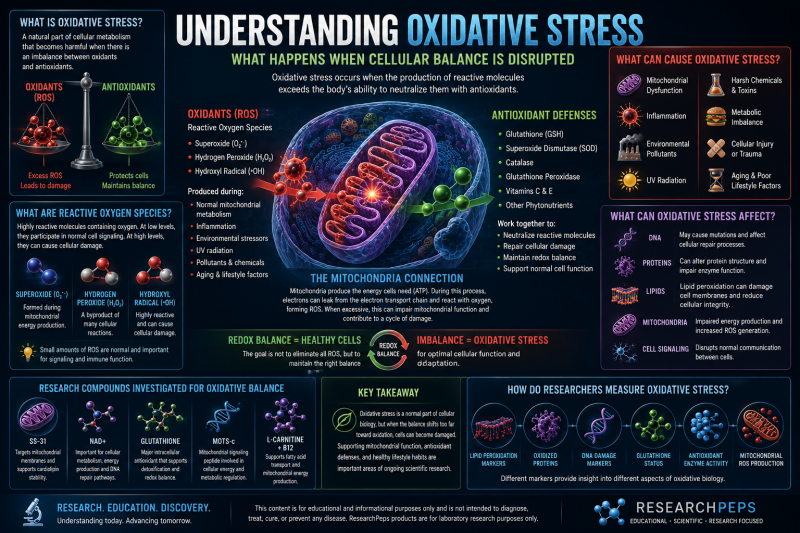
The body has its own antioxidant defense systems for controlling these molecules. Oxidative stress occurs when the production of reactive molecules exceeds the cell's ability to adequately manage them.
Understanding this balance is important because oxidative stress is studied across nearly every area of modern cellular biology.
🧬 What Are Reactive Oxygen Species?
Reactive oxygen species are oxygen-containing molecules that are chemically reactive.
Common examples include:
-
Superoxide
-
Hydrogen peroxide
-
Hydroxyl radicals
ROS are sometimes described simply as "bad" molecules, but that's an oversimplification.
At controlled levels, reactive oxygen species participate in normal processes such as:
-
Cellular signaling
-
Immune responses
-
Regulation of gene expression
-
Adaptation to cellular stress
The problem occurs when ROS production becomes excessive or antioxidant defenses become insufficient.
⚖️ Oxidants vs Antioxidants
Think of oxidative balance like a scale.
🔴 Oxidants
Reactive molecules are continuously produced through normal cellular processes and environmental exposures.
🟢 Antioxidant Defenses
Cells contain systems designed to neutralize or regulate reactive molecules.
When these two sides remain appropriately balanced, cells can maintain normal redox homeostasis.
When the balance shifts too far toward oxidation, oxidative stress can occur.
ROS Production → Antioxidant Defense → Cellular Balance
⚡ What Causes Oxidative Stress?
Oxidative stress doesn't have one single cause.
Researchers investigate many factors that can influence ROS production or antioxidant defenses, including:
-
Normal mitochondrial metabolism
-
Inflammatory processes
-
Environmental pollutants
-
Ultraviolet radiation
-
Certain chemicals
-
Cellular injury
-
Metabolic dysfunction
-
Aging-related cellular changes
Even normal energy production creates some reactive oxygen species.
This is one reason cells have developed extensive antioxidant systems.
🔋 The Mitochondria Connection
Mitochondria are often called the powerhouses of the cell because they help produce ATP, the molecule cells use as an immediate source of energy.
During mitochondrial energy production, electrons move through a series of proteins known as the electron transport chain.
Occasionally, electrons can react prematurely with oxygen and contribute to the formation of reactive oxygen species.
Normally, cells have systems capable of managing this activity.
However, mitochondrial dysfunction can alter this balance.
This creates an important area of research:
Mitochondrial dysfunction → Increased oxidative stress → Additional mitochondrial damage
Researchers investigate whether this cycle contributes to changes in cellular function over time.
🛡️ What Are Antioxidants?
Antioxidants are molecules capable of interacting with reactive species and helping maintain cellular redox balance.
The body produces several important antioxidant systems of its own.
These include:
Glutathione
Glutathione is one of the major intracellular antioxidants and plays an important role in maintaining cellular redox balance.
Superoxide Dismutase (SOD)
SOD enzymes help convert superoxide radicals into less reactive molecules.
Catalase
Catalase helps break hydrogen peroxide down into water and oxygen.
Glutathione Peroxidase
This family of enzymes uses glutathione to help reduce hydrogen peroxide and lipid peroxides.
Together, these systems provide cells with multiple layers of antioxidant defense.
🔬 What Can Oxidative Stress Affect?
When oxidative stress becomes excessive, reactive molecules can interact with important cellular structures.
Researchers investigate oxidative changes involving:
DNA
Reactive species can modify DNA bases and contribute to DNA damage.
Proteins
Oxidation can alter protein structure and potentially affect how proteins function.
Lipids
Reactive molecules can interact with lipids in cellular membranes through a process known as lipid peroxidation.
Mitochondria
Because mitochondria both produce and respond to ROS, mitochondrial biology and oxidative stress are closely connected.
🧪 What Is Redox Balance?
You'll often encounter the term redox in scientific literature.
Redox is short for reduction-oxidation.
Cells constantly perform oxidation and reduction reactions as part of normal metabolism.
Redox balance describes the regulated relationship between oxidizing and reducing processes within a biological system.
This means the goal of cellular biology isn't necessarily to eliminate every reactive oxygen species.
Instead, cells must maintain the appropriate balance.
💡 Did You Know?
Reactive oxygen species aren't always harmful.
Small and carefully regulated amounts of ROS function as cellular messengers.
Researchers sometimes refer to this concept as redox signaling.
Cells can use changes in ROS levels to help communicate information about their environment, metabolism, and stress.
This is why describing all oxidation as "bad" and all antioxidants as "good" doesn't accurately represent the biology.
🧬 Oxidative Stress & Cellular Aging Research
Oxidative stress has been studied extensively in aging biology.
One longstanding theory proposed that accumulated oxidative damage contributes significantly to biological aging.
Modern research has revealed a much more complicated picture.
Scientists now investigate interactions among:
-
Mitochondrial function
-
DNA repair
-
Protein maintenance
-
Cellular signaling
-
Inflammation
-
Metabolism
-
Antioxidant systems
-
Cellular senescence
Rather than oxidative stress acting as a single cause of aging, it appears to participate in a much larger network of cellular processes.
🔬 Why Is Oxidative Stress Important in Research?
Oxidative stress is investigated across many scientific fields because redox biology influences numerous cellular systems.
Research areas include:
-
Mitochondrial biology
-
Neurological research
-
Cardiovascular research
-
Metabolic research
-
Cellular aging
-
Exercise physiology
-
Immune signaling
-
Tissue biology
Researchers may measure oxidative stress markers to better understand how cells respond to different experimental conditions.
⚡ Research Compounds & Oxidative Stress
Several compounds in mitochondrial and cellular research are investigated in connection with oxidative stress, although they work through very different mechanisms.
CompoundArea of ResearchGlutathioneIntracellular antioxidant & redox regulationNAD+Cellular metabolism, redox reactions & mitochondrial functionSS-31Mitochondrial membrane & cardiolipin researchMOTS-cMitochondrial signaling & metabolic researchL-CarnitineFatty-acid transport & mitochondrial energy metabolism
These compounds should not be considered interchangeable simply because their research areas overlap.
Each interacts with cellular biology differently.
🧠 Oxidative Stress & Neurological Research
The brain has particularly high energy requirements and consumes substantial amounts of oxygen.
Because of this, researchers have extensively investigated oxidative stress in neurological biology.
Areas of investigation include:
-
Neuronal mitochondrial function
-
Protein aggregation
-
Neuroinflammation
-
Cellular energy metabolism
-
Antioxidant defense
-
Neuronal survival
This is one reason mitochondrial research compounds such as SS-31 are also studied within neurological laboratory models.
🔍 How Do Researchers Measure Oxidative Stress?
Scientists don't simply "see" oxidative stress.
Instead, researchers may measure biochemical markers associated with oxidative activity or antioxidant defenses.
Examples include:
-
Lipid peroxidation products
-
Oxidized proteins
-
Oxidative DNA damage markers
-
Glutathione status
-
Antioxidant enzyme activity
-
Mitochondrial ROS production
Different measurements provide information about different parts of the oxidative process.
Key Takeaways
-
Oxidative stress occurs when reactive molecule production and antioxidant defenses become imbalanced.
-
Reactive oxygen species are naturally produced during normal cellular metabolism.
-
ROS are not inherently harmful—they also participate in normal cellular signaling.
-
Mitochondria are closely connected to oxidative stress because of their role in cellular energy production.
-
Glutathione and antioxidant enzymes help cells regulate oxidative activity.
-
Excessive oxidative stress can affect DNA, proteins, lipids and mitochondrial function.
-
Modern research focuses on maintaining redox balance, rather than simply eliminating all reactive oxygen species.
📚 Continue Learning
-
L-Carnitine + B12
-
Understanding Cellular Energy
Educational Notice
This article is intended solely for educational and informational purposes. It summarizes scientific terminology, biological mechanisms, and areas of published research. It does not establish the safety, effectiveness, identity, purity, or approved use of any particular research material. Nothing in this article should be interpreted as medical advice, treatment guidance, dosing information, or a recommendation for human or animal use. ResearchPeps products are offered strictly for laboratory research purposes.