

GLOW Blend Research Guide
Educational Overview • Scientific Background • Current Research
Article Details
🕒 Estimated Reading Time: 9–11 minutes
📅 Last Reviewed: August 2026
📚 Research Category: Recovery & Tissue Research
🔬 Evidence Level: Primarily Preclinical Research
📖 Article Type: Educational Research Guide
What Is GLOW Blend?
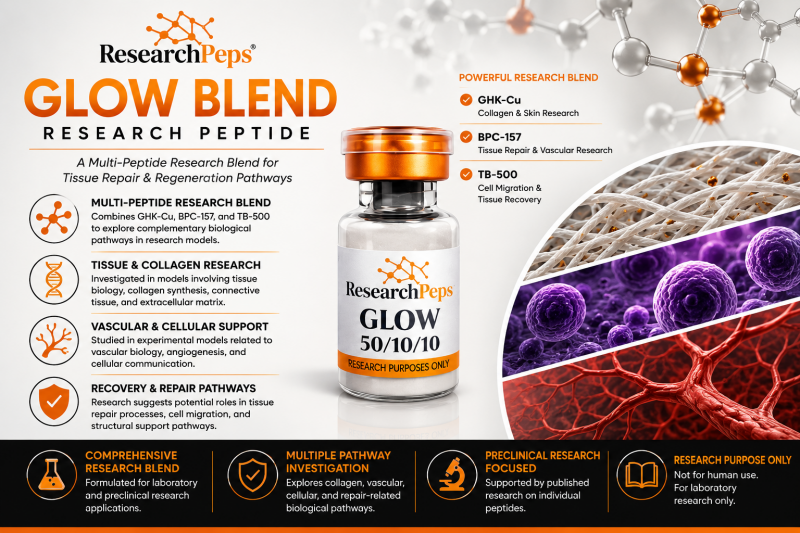
GLOW Blend is a multi-peptide research formulation that combines GHK-Cu, BPC-157, and TB-500 into a single investigational blend. Each component has been studied individually in laboratory and animal research involving tissue biology, connective tissue, vascular pathways, collagen biology, and cellular signaling.
Researchers investigate combination formulations like GLOW Blend to better understand how multiple compounds with distinct biological roles may be evaluated together within the same experimental model. Because the blend contains several investigational compounds, it should be considered its own research formulation rather than simply the sum of its individual ingredients.
Although substantial preclinical research exists for the individual compounds, direct published studies specifically evaluating GLOW Blend remain limited. This guide summarizes the current scientific literature for educational purposes while distinguishing established findings from areas that continue to be investigated.
Check it out here: https://researchpeps.org/product/glow-50-10-10/
Research Snapshot
Category Information
Research Name GLOW Blend
Classification Multi-Peptide Research Blend
Research Status Investigational Research Blend
Primary Research Areas Tissue Biology, Collagen Research, Connective Tissue, Vascular Biology, Cell Migration
Evidence Level Primarily Preclinical
Compounds in Blend GHK-Cu • BPC-157 • TB-500
At a Glance
What is GLOW Blend?
A multi-peptide research blend containing GHK-Cu, BPC-157, and TB-500.
Why is it researched?
Researchers study this combination to investigate multiple biological pathways involved in tissue biology, collagen organization, vascular signaling, and cellular communication.
Current Evidence
Most published literature consists of laboratory and animal studies involving the individual compounds. Direct research evaluating the blend itself remains limited.
Human Use
This article summarizes published scientific literature and is intended solely for educational purposes.
Why Researchers Study GLOW Blend
Researchers continue investigating GLOW Blend because it combines three compounds that have each been studied for different biological pathways. Combination research may help scientists explore how these pathways interact within controlled laboratory settings.
Current research interests include:
🧬 Tissue Biology
🩹 Connective Tissue Research
🧫 Collagen Organization
🩸 Vascular Biology
🌱 Cell Migration
🔬 Cellular Communication
🧩 Extracellular Matrix Research
🧬 Skin Biology
While these areas are actively investigated, the presence of multiple compounds in a blend does not automatically mean their effects are additive or fully understood.
Current Areas of Scientific Investigation
🩹 Tissue Biology
Researchers investigate tissue organization, remodeling, and normal biological repair processes using experimental laboratory models.
🧬 Collagen & Skin Biology
GHK-Cu has been studied in laboratory settings involving collagen biology, extracellular matrix organization, and skin-related research.
🩸 Vascular Biology
BPC-157 has been investigated in experimental studies involving vascular signaling and blood vessel biology.
🌱 Cell Migration
TB-500, modeled after thymosin beta-4, has been researched for its relationship with cell movement and structural protein dynamics.
🧩 Connective Tissue Research
Scientists continue studying how connective tissues organize and respond during normal biological processes in laboratory models.
🔬 Cellular Communication
Researchers investigate signaling pathways involved in tissue organization, extracellular matrix biology, and cellular coordination.
Quick Facts
✔ Multi-peptide investigational research blend
✔ Contains GHK-Cu, BPC-157, and TB-500
✔ Investigated across multiple biological pathways
✔ Most published evidence remains preclinical
✔ Direct human clinical research on the blend remains limited
Important Scientific Considerations
Each compound within GLOW Blend has been investigated independently in laboratory and animal research. However, combining multiple investigational compounds creates a distinct formulation that should be evaluated separately.
Current published literature does not establish that combining these compounds produces the same biological findings observed when each ingredient is studied individually. Additional research is needed to better understand the blend as its own investigational research material.
Key Takeaways
✔ GLOW Blend combines three investigational research peptides into one formulation.
✔ The individual compounds have been studied in tissue biology, collagen research, vascular biology, and cell migration.
✔ Most available evidence comes from laboratory and animal research.
✔ Direct published studies evaluating the blend itself remain limited.
✔ Additional research is needed to better understand how the combination behaves as a unique research formulation.
Continue Exploring Related Research
Related Recovery & Tissue Research
Explore research involving collagen biology, connective tissue, copper peptides, and skin biology.
Learn about tissue biology, vascular signaling, gastrointestinal research, and connective tissue studies.
Discover research involving thymosin beta-4, cell migration, actin regulation, and musculoskeletal biology.
➡️ BPC-157 + TB-500 Blend Research Guide
Learn how researchers investigate the combination of these two peptides within experimental models.
Explore a four-peptide investigational blend containing GHK-Cu, BPC-157, TB-500, and KPV.
Research involving immune signaling, inflammation-related pathways, and gastrointestinal biology.
Further Reading
The publications below include foundational peer-reviewed studies related to GHK-Cu, BPC-157, TB-500, and associated biological pathways. Because direct published research on GLOW Blend is limited, these references provide scientific background for understanding the individual compounds included in the formulation.
Selected References
GHK-Cu
1. Pickart L. (1973). The human plasma copper-binding peptide GHK and its biological significance. Nature.
2. Pickart L, Vasquez-Soltero JM, Margolina A. (2012). GHK-Cu: A naturally occurring peptide with multiple biological activities. Journal of Cosmetic Dermatology.
BPC-157
3. Krivic A, et al. (2006). Achilles detachment in rat and stable gastric pentadecapeptide BPC-157: Promoted tendon-to-bone healing and opposed corticosteroid aggravation. Journal of Orthopaedic Research, 24(5), 982–989.
4. Hsieh MJ, et al. (2017). Therapeutic potential of pro-angiogenic BPC-157 is associated with VEGFR2 activation and up-regulation. Journal of Molecular Medicine, 95(3), 323–333.
Thymosin Beta-4 / TB-500
5. Goldstein AL, Kleinman HK. (2015). Advances in the basic and clinical applications of thymosin beta-4. Expert Opinion on Biological Therapy.
6. Irobi E, et al. (2004). Structural basis of actin sequestration by thymosin beta-4: Implications for WH2 proteins. The EMBO Journal, 23(18), 3599–3608.
Educational Notice
The information presented in this article is intended solely for educational and informational purposes regarding published scientific research.
GLOW Blend is an investigational research formulation and is not approved by the U.S. Food and Drug Administration (FDA) for the diagnosis, treatment, cure, or prevention of any disease. References to scientific studies describe published laboratory and preclinical research and should not be interpreted as evidence of safety or effectiveness in humans.
This content is not medical advice and should not be used to make healthcare decisions.