

GLP Research Compounds
Understanding GLP-Related Metabolic Research
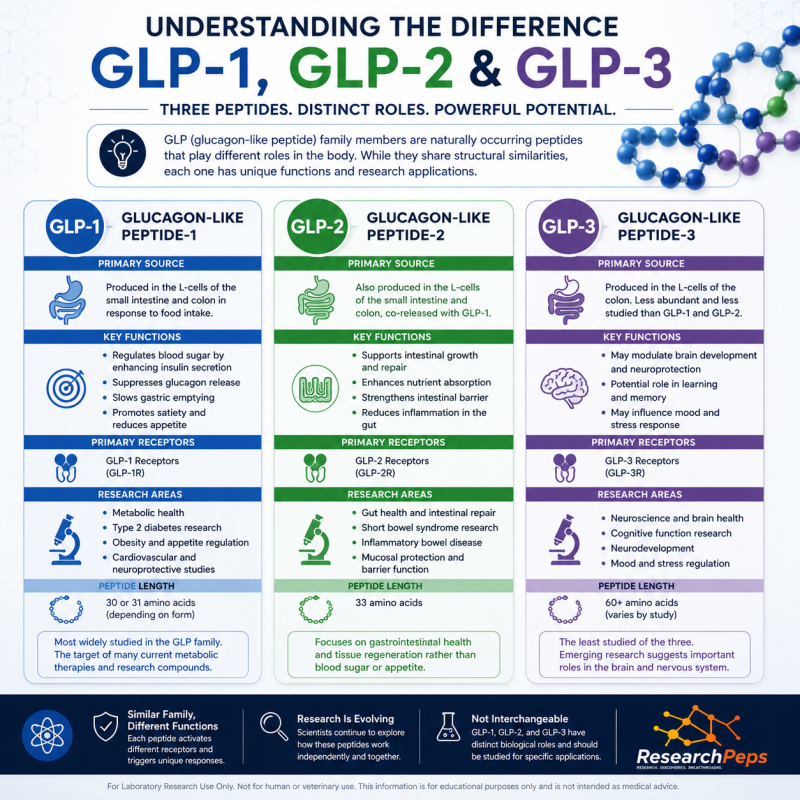
GLP-related compounds are widely studied for their roles in metabolic signaling, glucose regulation, appetite-related pathways, gastric activity, and energy balance. Research in this area includes compounds that interact with one or multiple receptor pathways, allowing scientists to examine how different signaling mechanisms influence metabolic processes.
Explore the individual research guides below to learn how these compounds differ and what researchers are currently studying.
GLP-1 — Semaglutide
Semaglutide is studied primarily for its activity at the GLP-1 receptor. Research examines its relationship with glucose-dependent signaling, appetite-related pathways, gastric activity, and metabolic regulation.
→ Explore Semaglutide (GLP1SM)
GLP-2 — Tirzepatide
Tirzepatide is studied as a dual GIP and GLP-1 receptor agonist, allowing researchers to investigate how two incretin-related signaling pathways may interact within metabolic systems.
→ Explore Tirzepatide (GLP2TZ)
GLP-3 — Retatrutide
Retatrutide is being investigated for its activity across GLP-1, GIP, and glucagon receptors. This triple-receptor activity has made it an area of interest in research involving metabolic signaling, energy balance, and related pathways.
→ Explore Retatrutide (GLP-3RT)
Cagrilintide
Cagrilintide is studied in connection with amylin-related signaling and its potential influence on appetite, satiety, gastric activity, and metabolic pathways. Its mechanism differs from GLP receptor agonists, making it useful for comparison within metabolic research.
→ Explore Cagrilintide (Cag)
Compare GLP Research Compounds
Want to understand how these research compounds differ?
Explore our comparison guide covering receptor targets, signaling mechanisms, and key areas of scientific investigation.