

Kisspeptin Research Guide
Educational Overview • Scientific Background • Current Research
Article Details
🕒 Estimated Reading Time: 8–10 minutes
📅 Last Reviewed: August 2026
📚 Research Category: Growth Hormone & Endocrine Research
🔬 Evidence Level: Human & Preclinical Research
📖 Article Type: Educational Research Guide
What Is Kisspeptin?
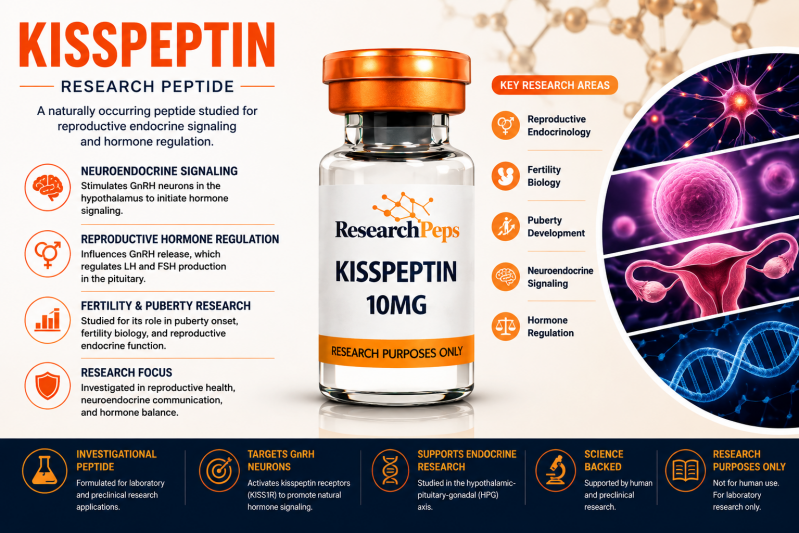
Kisspeptin is a naturally occurring signaling peptide that plays a central role in the regulation of the reproductive endocrine system. First identified through research involving the KISS1 gene, Kisspeptin acts on specialized receptors within the hypothalamus to stimulate the release of Gonadotropin-Releasing Hormone (GnRH).
GnRH serves as the master hormone controlling the hypothalamic-pituitary-gonadal (HPG) axis. Once released, GnRH stimulates the pituitary gland to produce Luteinizing Hormone (LH) and Follicle-Stimulating Hormone (FSH), two hormones involved in reproductive physiology.
Because of this central role, Kisspeptin has become an important research tool for scientists studying reproductive endocrinology, fertility biology, puberty, hormone regulation, and neuroendocrine signaling.
Check it out here: https://researchpeps.org/product/kisspeptin-10mg/
Research Snapshot
Category Information
Research Name Kisspeptin
Classification Neuroendocrine Signaling Peptide
Research Status Investigational Research Peptide
Primary Research Areas Reproductive Endocrinology, Fertility Biology, Puberty, Hormone Regulation
Evidence Level Human & Preclinical Research
Primary Target GnRH Neurons
At a Glance
What is Kisspeptin?
A naturally occurring signaling peptide that regulates reproductive hormone release through activation of GnRH neurons.
Why is it researched?
Researchers investigate Kisspeptin because it plays a key role in reproductive hormone regulation, fertility biology, puberty, and neuroendocrine communication.
Current Evidence
Published human and laboratory research continues exploring Kisspeptin's role in endocrine physiology and reproductive health.
Human Use
This article summarizes published scientific literature for educational purposes only.
Why Researchers Study Kisspeptin
Kisspeptin functions near the top of the reproductive hormone signaling cascade.
Rather than acting directly on reproductive organs, it stimulates GnRH neurons located in the hypothalamus, initiating a sequence of hormonal events involving:
- Gonadotropin-Releasing Hormone (GnRH)
- Luteinizing Hormone (LH)
- Follicle-Stimulating Hormone (FSH)
This makes Kisspeptin valuable for investigating how the brain communicates with the reproductive endocrine system.
Current research interests include:
🧬 Reproductive Endocrinology
👶 Fertility Biology
📈 Puberty Development
🧠 Neuroendocrine Signaling
⚖️ Hormone Regulation
🔬 Women's Health Research
Current Areas of Scientific Investigation
🧬 Reproductive Endocrinology
Kisspeptin is considered one of the primary regulators of the hypothalamic-pituitary-gonadal (HPG) axis.
Researchers continue studying how Kisspeptin influences reproductive hormone signaling.
👶 Fertility Biology
Because Kisspeptin regulates GnRH secretion, it has become an important area of fertility research involving both male and female reproductive physiology.
📈 Puberty Research
One of the most significant discoveries involving Kisspeptin is its role in initiating puberty.
Scientists continue investigating how Kisspeptin signaling changes throughout development.
⚖️ Hormonal Regulation
Researchers examine how Kisspeptin interacts with multiple endocrine feedback systems that influence reproductive hormone production.
🧠 Neuroendocrine Communication
Kisspeptin provides an important communication pathway between the brain and reproductive endocrine organs, making it valuable for neuroendocrine research.
🔬 Women's Health Research
Researchers continue investigating Kisspeptin's role throughout the female reproductive cycle, ovulation, and other aspects of reproductive physiology.
How Kisspeptin Works
Researchers generally describe the signaling pathway as follows:
Kisspeptin
↓
Stimulates GnRH neurons
↓
GnRH Release
↓
Pituitary releases LH & FSH
↓
Hormonal signaling to reproductive organs
Because Kisspeptin acts near the beginning of this pathway, researchers consider it one of the body's key reproductive signaling molecules.
Quick Facts
✔ Naturally occurring signaling peptide
✔ Encoded by the KISS1 gene
✔ Activates GnRH neurons
✔ Investigated in fertility and reproductive research
✔ Human and laboratory studies continue
Important Scientific Considerations
Although Kisspeptin has become one of the most extensively studied reproductive signaling peptides, many questions remain regarding its broader physiological roles.
Current research continues examining how Kisspeptin interacts with other neuroendocrine pathways involved in metabolism, energy balance, and hormone regulation.
As with many investigational peptides, published findings continue to evolve as additional research becomes available.
Key Takeaways
✔ Kisspeptin is a naturally occurring neuroendocrine signaling peptide.
✔ It stimulates GnRH release from the hypothalamus.
✔ Researchers study reproductive endocrinology, fertility biology, puberty, and hormone regulation.
✔ Human and laboratory studies continue expanding scientific understanding.
✔ Additional research remains ongoing.
Continue Exploring Related Research
Related Growth Hormone & Endocrine Research
Research involving Growth Hormone-Releasing Hormone physiology.
Endocrine and metabolic research.
➡️ CJC-1295 (No DAC) Research Guide
Research involving GHRH analogs and growth hormone signaling.
Selective Growth Hormone Secretagogue research.
Research involving gonadotropin biology and reproductive hormone physiology.
Understand the differences between extended-acting and short-acting GHRH analogs.
Further Reading
The publications below represent foundational scientific literature related to Kisspeptin and reproductive endocrine research.
Selected References
Kisspeptin Research
1. de Roux N, et al. (2003). Hypogonadotropic hypogonadism due to loss of function of the KiSS1-derived peptide receptor GPR54. Proceedings of the National Academy of Sciences.
2. Seminara SB, et al. (2003). The GPR54 gene as a regulator of puberty. New England Journal of Medicine.
3. Dhillo WS, et al. (2005). Kisspeptin stimulates gonadotropin release in healthy men. Journal of Clinical Endocrinology & Metabolism.
Reproductive Endocrinology
4. Pinilla L, Aguilar E, Dieguez C, et al. (2012). Kisspeptins and reproduction. Physiological Reviews.
5. Oakley AE, Clifton DK, Steiner RA. (2009). Kisspeptin signaling in the brain. Endocrine Reviews.
6. Clarke IJ. (2015). Hypothalamic control of reproduction through Kisspeptin neurons. Journal of Neuroendocrinology.
Educational Notice
The information presented in this article is intended solely for educational and informational purposes regarding published scientific research.
Kisspeptin is an investigational research peptide. References to scientific studies describe published laboratory, preclinical, and human research and should not be interpreted as evidence of safety or effectiveness for any particular use.
This content is not medical advice and should not be used to diagnose, treat, cure, or prevent any disease.