

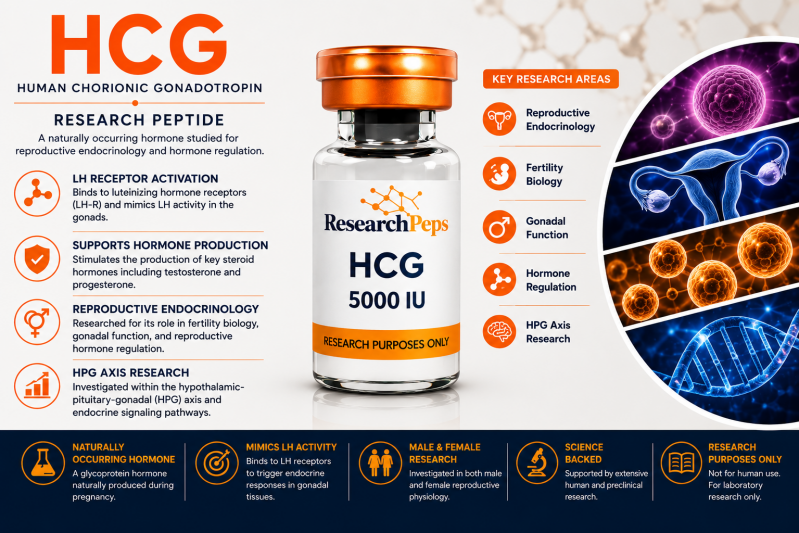
HCG Research Guide
Educational Overview • Scientific Background • Current Research
Article Details
🕒 Estimated Reading Time: 8–10 minutes
📅 Last Reviewed: August 2026
📚 Research Category: Growth Hormone & Endocrine Research
🔬 Evidence Level: Human & Preclinical Research
📖 Article Type: Educational Research Guide
What Is HCG?
Human Chorionic Gonadotropin (HCG) is a naturally occurring glycoprotein hormone produced during pregnancy. It is secreted primarily by placental cells shortly after implantation and plays an essential role in supporting early pregnancy by maintaining progesterone production.
Outside of pregnancy, HCG has become an important tool in endocrine research because its structure closely resembles Luteinizing Hormone (LH). Due to this similarity, researchers use HCG to study reproductive endocrinology, gonadal function, steroid hormone production, fertility biology, and hypothalamic-pituitary-gonadal (HPG) axis regulation.
Today, HCG continues to be widely investigated in both laboratory and clinical research involving male and female reproductive physiology.
Check it out here: https://researchpeps.org/product/hcg-4500iu/
Research Snapshot
Category Information
Research Name Human Chorionic Gonadotropin (HCG)
Classification Glycoprotein Hormone
Research Status Investigational Research Hormone
Primary Research Areas Reproductive Endocrinology, Fertility Biology, Gonadal Function, Hormone Regulation
Evidence Level Human & Preclinical Research
Related Hormone Luteinizing Hormone (LH)
At a Glance
What is HCG?
A naturally occurring hormone studied for its role in reproductive endocrinology and hormone regulation.
Why is it researched?
Researchers investigate HCG because of its similarity to luteinizing hormone (LH) and its role in reproductive hormone signaling.
Current Evidence
Published human and laboratory studies continue exploring HCG in fertility, endocrine physiology, and gonadal biology.
Human Use
This article summarizes published scientific literature for educational purposes only.
Why Researchers Study HCG
HCG binds to the same receptors as luteinizing hormone (LH), making it a valuable research tool for understanding reproductive hormone signaling.
Researchers continue investigating HCG in studies involving:
🧬 Reproductive Endocrinology
👶 Fertility Biology
🧠 Hormone Regulation
⚖️ Gonadal Function
🧪 Steroid Hormone Production
🔬 Hypothalamic-Pituitary-Gonadal Axis Research
Current Areas of Scientific Investigation
🧬 Reproductive Endocrinology
HCG is widely studied because it activates LH receptors involved in reproductive hormone regulation.
Researchers continue examining how this signaling pathway influences endocrine physiology.
👶 Fertility Biology
HCG has become an important research tool in studies involving ovarian physiology, ovulation biology, and reproductive function.
Researchers also investigate its role in male reproductive physiology.
⚖️ Hormone Regulation
Scientists continue examining how HCG influences steroid hormone production through LH receptor activation.
Research includes testosterone production, progesterone regulation, and endocrine feedback mechanisms.
🧪 Gonadal Function
Laboratory studies investigate how HCG affects normal ovarian and testicular physiology within experimental models.
🧠 HPG Axis Research
Researchers continue studying how HCG interacts with the hypothalamic-pituitary-gonadal axis to better understand reproductive hormone communication.
🔬 Pregnancy Biology
Because HCG is naturally produced during pregnancy, scientists continue investigating its biological role in implantation, placental development, and maternal endocrine adaptations.
How HCG Works
Researchers generally describe the signaling pathway as follows:
HCG
↓
Activates LH Receptors
↓
Stimulates Gonadal Hormone Production
↓
Endocrine Signaling
↓
Reproductive Physiology
Because HCG mimics LH activity, researchers frequently use it to study reproductive hormone pathways.
HCG vs LH
Although HCG and LH are different hormones, they share significant structural similarities.
Luteinizing Hormone (LH)
✔ Naturally produced by the pituitary gland
✔ Shorter biological activity
✔ Regulates reproductive hormone signaling
Human Chorionic Gonadotropin (HCG)
✔ Produced during pregnancy
✔ Similar receptor activity to LH
✔ Longer biological activity
Researchers investigate both hormones because they activate the same receptor while exhibiting different pharmacokinetic properties.
Quick Facts
✔ Naturally occurring hormone
✔ Structurally similar to LH
✔ Studied in reproductive endocrinology
✔ Human and laboratory research available
✔ Investigated in fertility biology and hormone regulation
Important Scientific Considerations
Although HCG has been studied for decades, research continues exploring its broader physiological roles beyond pregnancy.
Current investigations include endocrine regulation, reproductive biology, and hormone signaling within both male and female experimental models.
As with many investigational compounds, published findings continue to evolve as new research becomes available.
Key Takeaways
✔ HCG is a naturally occurring glycoprotein hormone.
✔ It activates luteinizing hormone receptors.
✔ Researchers investigate fertility, reproductive endocrinology, and hormone regulation.
✔ Human and laboratory studies continue expanding scientific understanding.
✔ Additional research remains ongoing.
Continue Exploring Related Research
Related Growth Hormone & Endocrine Research
Explore neuroendocrine regulation of reproductive hormones.
Research involving growth hormone-releasing hormone physiology.
Metabolism and endocrine regulation research.
➡️ CJC-1295 (No DAC) Research Guide
Growth hormone physiology and GHRH analog research.
Selective growth hormone secretagogue research.
Learn the difference between extended-acting and short-acting GHRH analogs.
Further Reading
The publications below represent foundational scientific literature related to HCG and reproductive endocrinology.
Selected References
Human Chorionic Gonadotropin
1. Cole LA. (2010). Biological functions of hCG and hCG-related molecules. Reproductive Biology and Endocrinology.
2. Cole LA. (2012). hCG, the wonder of today's science. Reproductive Biology and Endocrinology.
Reproductive Endocrinology
3. Pierce JG, Parsons TF. (1981). Glycoprotein hormones: Structure and function. Annual Review of Biochemistry.
4. Ascoli M, Fanelli F, Segaloff DL. (2002). The luteinizing hormone/choriogonadotropin receptor. Endocrine Reviews.
Fertility & Hormone Regulation
5. Filicori M, et al. (2005). Novel concepts of human chorionic gonadotropin in reproductive medicine. Human Reproduction Update.
6. Casarini L, Simoni M. (2019). The LH/HCG receptor in reproductive physiology. International Journal of Molecular Sciences.
Educational Notice
The information presented in this article is intended solely for educational and informational purposes regarding published scientific research.
Human Chorionic Gonadotropin (HCG) is discussed here within the context of laboratory, preclinical, and clinical scientific literature. References to published studies should not be interpreted as evidence of safety or effectiveness for any particular use.
This content is not medical advice and should not be used to diagnose, treat, cure, or prevent any disease.