

Tesamorelin Research Guide
Educational Overview • Scientific Background • Current Research
Article Details
🕒 Estimated Reading Time: 8–10 minutes
📅 Last Reviewed: August 2026
📚 Research Category: Growth Hormone & Endocrine Research
🔬 Evidence Level: Human & Preclinical Research
📖 Article Type: Educational Research Guide
What Is Tesamorelin?
Tesamorelin is a synthetic analog of Growth Hormone-Releasing Hormone (GHRH) that has been developed to stimulate the pituitary gland's natural release of growth hormone. It differs from native GHRH by containing structural modifications that increase stability and extend its biological activity.
Rather than acting as growth hormone itself, Tesamorelin works upstream within the endocrine system by activating GHRH receptors on pituitary cells. This stimulation leads to the body's own pulsatile release of growth hormone, making Tesamorelin an important research tool for investigating endocrine physiology, metabolism, lipid regulation, body composition, aging biology, and growth hormone signaling.
Because Tesamorelin has been evaluated in both clinical and laboratory research, it remains one of the more extensively studied peptides within the Growth Hormone-Releasing Hormone family.
Check it out here: https://researchpeps.org/product/tesamorelin-10mg/
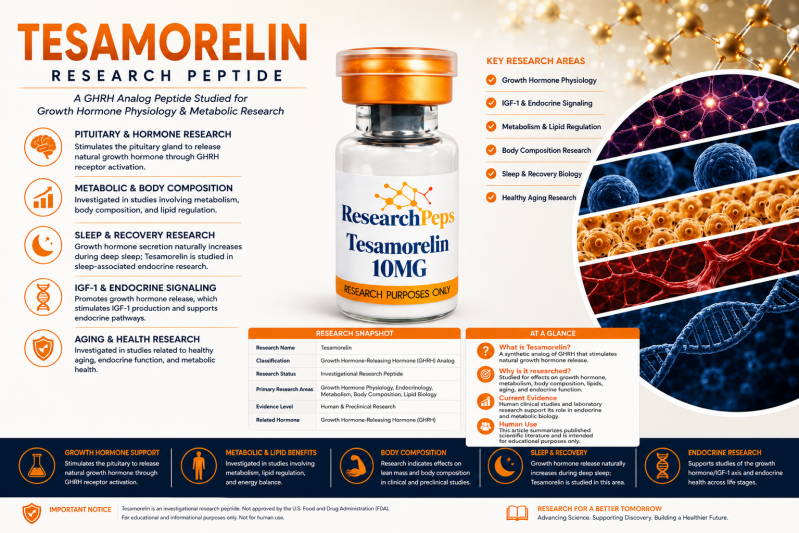
Research Snapshot
Category Information
Research Name Tesamorelin
Classification Growth Hormone-Releasing Hormone (GHRH) Analog
Research Status Investigational Research Peptide
Primary Research Areas Growth Hormone Physiology, Endocrinology, Metabolism, Body Composition, Lipid Biology
Evidence Level Human & Preclinical Research
Related Hormone Growth Hormone-Releasing Hormone (GHRH)
At a Glance
What is Tesamorelin?
A synthetic analog of Growth Hormone-Releasing Hormone designed to stimulate natural growth hormone secretion.
Why is it researched?
Researchers investigate Tesamorelin to better understand endocrine regulation, metabolism, body composition, lipid biology, aging, and growth hormone physiology.
Current Evidence
Human clinical studies and laboratory research have examined Tesamorelin in multiple areas of endocrine and metabolic biology.
Human Use
This article summarizes published scientific literature and is intended solely for educational purposes.
Why Researchers Study Tesamorelin
Researchers continue studying Tesamorelin because it stimulates one of the body's natural hormonal signaling pathways while maintaining endogenous regulation of growth hormone secretion.
Current research interests include:
🧬 Growth Hormone Physiology
⚖️ Metabolic Regulation
📈 IGF-1 Biology
💪 Body Composition
🧪 Lipid Metabolism
😴 Sleep Biology
🧠 Endocrine Function
🔬 Healthy Aging Research
Scientists continue investigating how growth hormone signaling influences numerous biological systems throughout the body.
Current Areas of Scientific Investigation
🧬 Growth Hormone Physiology
Researchers study how Tesamorelin stimulates pituitary growth hormone secretion while preserving the body's normal endocrine feedback mechanisms.
📈 IGF-1 Regulation
Growth hormone stimulates production of insulin-like growth factor-1 (IGF-1), making Tesamorelin valuable for investigating the GH/IGF-1 signaling pathway.
⚖️ Metabolism & Lipid Biology
Researchers investigate Tesamorelin's relationship with metabolism, lipid regulation, energy balance, and endocrine physiology.
💪 Body Composition Research
Laboratory and clinical studies continue investigating how endogenous growth hormone signaling influences lean tissue, adipose tissue, and overall body composition.
😴 Sleep Biology
Because natural growth hormone secretion increases during deep sleep, researchers study Tesamorelin within models of sleep-associated endocrine physiology.
🧠 Healthy Aging Research
Age-related changes in growth hormone production have made Tesamorelin an area of interest for investigating endocrine aging and hormone regulation.
Quick Facts
✔ Synthetic GHRH analog
✔ Stimulates endogenous growth hormone release
✔ Investigated in human clinical and laboratory research
✔ Studied extensively in endocrine physiology
✔ Continues to be researched in metabolism and lipid biology
Important Scientific Considerations
Tesamorelin stimulates the body's own production of growth hormone rather than supplying growth hormone directly.
Researchers distinguish this mechanism from recombinant human growth hormone because normal endocrine feedback regulation remains intact.
Although Tesamorelin has been studied in humans, additional research continues regarding long-term endocrine physiology and broader biological applications.
Key Takeaways
✔ Tesamorelin is a synthetic analog of Growth Hormone-Releasing Hormone.
✔ Researchers investigate its effects on pituitary hormone secretion.
✔ Human clinical studies have evaluated endocrine physiology and metabolism.
✔ Research continues regarding lipid biology, body composition, and healthy aging.
✔ Additional investigation remains necessary to fully understand long-term biological effects.
Continue Exploring Related Research
Related Growth Hormone & Endocrine Research
Explore research involving endogenous growth hormone regulation and pituitary physiology.
➡️ CJC-1295 (No DAC) Research Guide
Learn about longer-acting Growth Hormone-Releasing Hormone analog research.
➡️ CJC-1295 + Ipamorelin Research Guide
Discover combination peptide research involving GHRH and ghrelin receptor signaling.
Explore selective growth hormone secretagogue research.
Learn about reproductive hormone regulation and endocrine signaling.
Discover research involving gonadotropin physiology and endocrine biology.
Further Reading
The publications below represent foundational peer-reviewed studies related to Tesamorelin, Growth Hormone-Releasing Hormone physiology, pituitary biology, metabolism, and endocrine function.
Selected References
Tesamorelin
1. Falutz J, et al. (2010). Effects of Tesamorelin on visceral adipose tissue and metabolic parameters. New England Journal of Medicine.
2. Stanley TL, Grinspoon SK. (2015). Effects of growth hormone-releasing hormone analog therapy on body composition and metabolism. Journal of Clinical Endocrinology & Metabolism.
Growth Hormone Physiology
3. Mayo KE, et al. (2000). Growth Hormone-Releasing Hormone: Physiology and clinical applications. Endocrine Reviews.
4. Giustina A, Veldhuis JD. (1998). Pathophysiology of the somatotropic axis. Endocrine Reviews.
IGF-1 & Endocrine Biology
5. Ho KY, et al. (1987). Effects of age on growth hormone secretion in healthy adults. Journal of Clinical Investigation.
6. Veldhuis JD, Iranmanesh A. (2006). Neuroendocrine regulation of growth hormone secretion. Endocrine Reviews.
Educational Notice
The information presented in this article is intended solely for educational and informational purposes regarding published scientific research.
Tesamorelin is an investigational research peptide in many research contexts. References to scientific studies describe published laboratory, preclinical, and human research and should not be interpreted as evidence of safety or effectiveness for any particular use.
This content is not medical advice and should not be used to make healthcare decisions.