

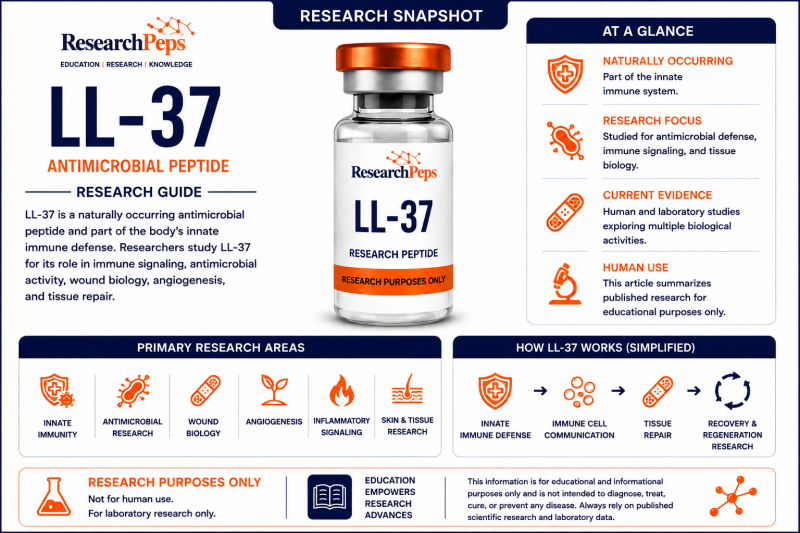
LL-37 Research Guide
Educational Overview • Scientific Background • Current Research
Article Details
🕒 Estimated Reading Time: 8–10 minutes
📅 Last Reviewed: August 2026
📚 Research Category: Recovery & Tissue Research
🔬 Evidence Level: Human & Preclinical Research
📖 Article Type: Educational Research Guide
Researchers investigate LL-37 in areas including antimicrobial biology, immune signaling, inflammatory pathways, wound biology, angiogenesis, and tissue biology.
LL-37 is a naturally occurring antimicrobial peptide belonging to the cathelicidin family. It is produced by various cells throughout the body, including immune cells and epithelial cells that line the skin, respiratory tract, and gastrointestinal tract.
Unlike many research peptides that focus on endocrine signaling or cellular metabolism, LL-37 is primarily studied for its role in the body's innate immune system. Researchers investigate how it contributes to antimicrobial defense, immune signaling, inflammation, wound biology, angiogenesis, and tissue repair.
Because of its broad biological activity, LL-37 has become one of the most extensively studied antimicrobial peptides in modern immunology.
Research Snapshot
Category Information
Research Name LL-37
Classification Naturally Occurring Antimicrobial Peptide
Research Status Investigational Research Peptide
Primary Research Areas Innate Immunity, Wound Biology, Angiogenesis, Inflammation Research
Evidence Level Human & Preclinical Research
Primary Target Innate Immune System & Tissue Biology
At a Glance
What is LL-37?
A naturally occurring antimicrobial peptide that forms part of the body's innate immune defense.
Why is it researched?
Researchers investigate LL-37 because of its involvement in immune signaling, wound biology, tissue repair, and antimicrobial research.
Current Evidence
Published laboratory and human studies continue exploring LL-37 across multiple areas of immunology and regenerative biology.
Human Use
This article summarizes published scientific literature for educational purposes only.
How It Fits Within the Immune System
LL-37 is part of the body's first line of immune defense, known as the innate immune system.
Rather than acting like hormones, LL-37 is studied for its involvement in immune-cell communication, antimicrobial biology, and tissue-related biological processes.
Simplified Research Pathway
Primary Research Focus: Innate immunity and tissue regeneration.
Why Researchers Study LL-37
Scientists continue investigating LL-37 because it participates in several important biological systems.
Current research interests include:
🛡️ Innate Immunity
🧬 Antimicrobial Biology
🩹 Wound Research
🧫 Tissue Repair
🌱 Angiogenesis
🔥 Inflammatory Signaling
🔬 Skin Biology
🦠 Host Defense
Current Areas of Scientific Investigation
🛡️ Innate Immunity
LL-37 is widely studied because it forms part of the body's natural antimicrobial defense system.
Researchers continue investigating its role in immune cell communication and host defense.
🧫 Antimicrobial Research
Published studies explore LL-37's interactions with bacteria, viruses, fungi, and other microorganisms in laboratory models.
🩹 Wound Biology
Scientists continue investigating how LL-37 participates in normal tissue repair and wound healing processes.
🌱 Angiogenesis
Researchers study LL-37 because of its interaction with pathways involved in blood vessel formation during tissue repair.
🔬 Skin Biology
LL-37 is naturally present in skin and epithelial tissues, making it an important area of investigation in dermatological research.
🔥 Immune Signaling
Current studies explore how LL-37 helps regulate communication between immune cells during normal inflammatory responses.
LL-37 and Immune Signaling Research
Researchers generally describe the process as follows:
Innate Immunity
↓
LL-37
↓
Immune Communication
↓
Tissue Repair
↓
Recovery Research
↓
Host Defense Biology
Scientists continue studying these pathways to better understand immune function and tissue biology.
Why LL-37 Is Unique
Unlike peptides that regulate hormones or cellular metabolism, LL-37 is naturally produced as part of the body's innate immune response.
Its ability to participate in antimicrobial defense, immune communication, angiogenesis, and tissue biology makes it one of the most versatile peptides studied in immunology.
Quick Facts
✔ Naturally occurring antimicrobial peptide
✔ Member of the cathelicidin family
✔ Studied in innate immunity
✔ Human and laboratory studies available
✔ Research continues expanding
Important Scientific Considerations
Although LL-37 has been studied extensively, scientists continue investigating its complex biological mechanisms.
Current research includes innate immunity, inflammatory signaling, wound biology, angiogenesis, skin research, and antimicrobial defense.
As with many investigational compounds, additional research continues to improve scientific understanding.
Key Takeaways
✔ LL-37 is a naturally occurring antimicrobial peptide.
✔ Researchers study innate immunity and tissue biology.
✔ Research includes antimicrobial defense, wound biology, angiogenesis, and immune signaling.
✔ Human and laboratory studies continue expanding scientific understanding.
✔ Additional research remains ongoing.
Continue Exploring Related Research
Related Recovery & Tissue Research
Research involving connective tissue biology and regeneration.
Studies involving cell migration and tissue remodeling.
Research involving immune signaling and inflammatory pathways.
A multi-peptide blend containing GHK-Cu, BPC-157, and TB-500.
A four-peptide blend combining GHK-Cu, BPC-157, TB-500, and KPV.
Further Reading
The publications below represent foundational scientific literature related to LL-37.
Selected References
LL-37 Research
1. Dürr UH, Sudheendra US, Ramamoorthy A. (2006). LL-37, the only human member of the cathelicidin family of antimicrobial peptides. Biochimica et Biophysica Acta.
2. Wang G. (2014). Human antimicrobial peptides and proteins. Pharmaceuticals.
Innate Immunity
3. Nijnik A, Hancock REW. (2009). Host defence peptides: Antimicrobial and immunomodulatory activity. Trends in Immunology.
4. Zanetti M. (2005). The role of cathelicidins in innate immunity. Current Issues in Molecular Biology.
Tissue Biology
5. Heilborn JD, et al. (2003). The cathelicidin antimicrobial peptide LL-37 is involved in re-epithelialization of human skin wounds. Journal of Investigative Dermatology.
6. National Library of Medicine. Published studies involving LL-37 and innate immunity.
Educational Notice
The information presented in this article is intended solely for educational and informational purposes regarding published scientific research.
LL-37 is an investigational research peptide. References to laboratory, preclinical, and human studies summarize current scientific knowledge and should not be interpreted as evidence of safety or effectiveness for any specific use.
This content is not medical advice and should not be used to diagnose, treat, cure, or prevent any disease.