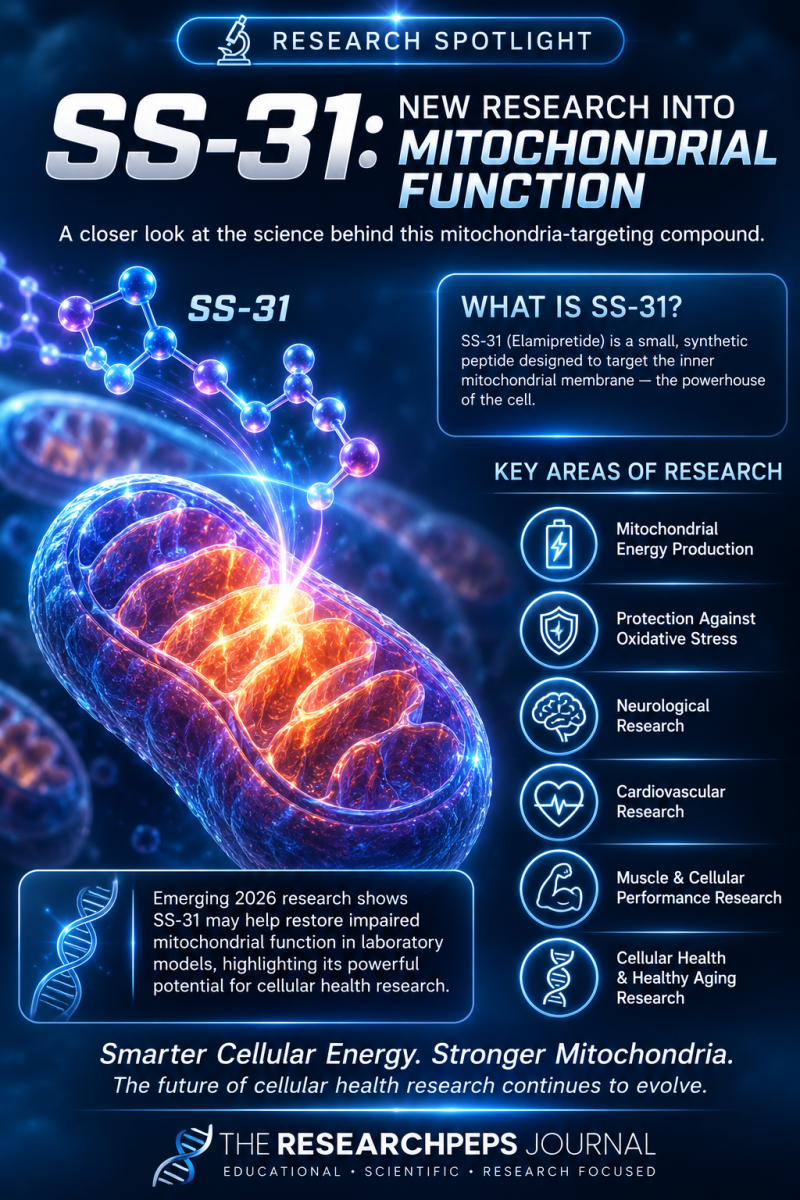
Research Spotlight: SS-31 — New Research Into Mitochondrial Function
What Are Researchers Discovering About SS-31?
Mitochondria are responsible for much more than simply producing cellular energy. They also participate in oxidative balance, cellular signaling, metabolism, and responses to cellular stress.
A 2026 study has added another interesting piece to the growing body of SS-31 research.
Read the study here: https://pubmed.ncbi.nlm.nih.gov/42219795/
Researchers from Imperial College London investigated SS-31 (Elamipretide) and its interaction with α-synuclein—a protein heavily studied in neurological research because abnormal accumulation of α-synuclein is associated with Parkinson's disease and related disorders.
The researchers were particularly interested in whether SS-31 could influence α-synuclein's interaction with cellular membranes and the mitochondrial dysfunction associated with α-synuclein oligomers.
🧬 What Is SS-31?
SS-31, also known as Elamipretide, is a small synthetic tetrapeptide designed to target mitochondria.
A major area of SS-31 research involves its interaction with cardiolipin, a specialized lipid found within the inner mitochondrial membrane.
Cardiolipin is important for:
- Mitochondrial membrane structure
- Organization of mitochondrial proteins
- Electron transport
- Oxidative phosphorylation
- Cellular energy production
Because of this mitochondrial targeting, researchers have investigated SS-31 across a variety of experimental models involving mitochondrial dysfunction.
🧠 What Did the 2026 Study Investigate?
The researchers examined how SS-31 interacted with α-synuclein and lipid membranes.
α-Synuclein is normally found in the nervous system, but abnormal aggregation of this protein is an important area of neurological disease research.
The researchers wanted to determine whether SS-31 could influence:
- α-Synuclein binding to lipid membranes
- α-Synuclein aggregation
- Mitochondrial impairment associated with α-synuclein oligomers
- Cellular uptake of α-synuclein oligomers
- Cell viability
🔬 What Did Researchers Find?
The laboratory results were particularly interesting.
Researchers reported that SS-31 could displace α-synuclein from negatively charged lipid membranes in a concentration-dependent manner.
They also observed changes in α-synuclein aggregation and fibril morphology.
But one of the most notable findings involved the mitochondria.
In neuroblastoma cells exposed to α-synuclein oligomers, researchers reported that SS-31:
- Improved cell viability
- Restored impaired mitochondrial function
- Influenced α-synuclein interaction with lipid membranes
- Reduced cellular uptake of α-synuclein oligomers
The researchers proposed that interactions between SS-31, lipid membranes, and α-synuclein may contribute to these mitochondrial effects.
⚡ Why Is the Mitochondrial Finding Interesting?
Mitochondrial dysfunction is an important area of research across many fields of biology.
When mitochondrial function becomes impaired, cells may experience changes involving:
- ATP production
- Oxidative stress
- Cellular metabolism
- Membrane function
- Cellular signaling
The 2026 study is interesting because it suggests SS-31's relationship with mitochondrial biology may extend beyond simply influencing energy production.
Researchers are continuing to investigate how mitochondrial membranes themselves participate in cellular dysfunction and how mitochondria-targeting compounds interact with those membranes.
🧠 Why α-Synuclein?
α-Synuclein is a protein found primarily in neurons.
Researchers are particularly interested in what happens when this protein begins forming abnormal aggregates.
Abnormal α-synuclein accumulation is strongly associated with Parkinson's disease and other disorders collectively known as synucleinopathies.
This does not mean the study established SS-31 as a treatment for Parkinson's disease.
Instead, the research provides laboratory evidence that SS-31 may influence some of the cellular and mitochondrial processes associated with α-synuclein.
Much more research would be required to understand the significance of these findings.
🔎 SS-31 Research Isn't Limited to One Area
Other research published in 2026 further demonstrates the variety of experimental models in which SS-31 is being investigated.
Researchers studying a rat model of heart failure with preserved ejection fraction (HFpEF) reported improvements in several measurements of skeletal-muscle and mitochondrial function following elamipretide treatment.
Another 2026 study involving spinal cord injury in mice and cultured cells investigated SS-31 in relation to mitochondrial bioenergetics, oxidative stress, neuronal preservation, and neural remodeling.
These studies involve very different experimental models, but mitochondria are the common thread.
💡 Research Spotlight Takeaway
The emerging research surrounding SS-31 highlights an important direction in modern cellular biology:
Instead of simply asking how much energy mitochondria produce, researchers are investigating how the structure and function of mitochondrial membranes influence the health of the entire cell.
SS-31 is particularly interesting to researchers because it targets the inner mitochondrial membrane and interacts with cardiolipin.
The newest research continues expanding our understanding of how this interaction may influence mitochondrial bioenergetics, oxidative stress, protein interactions, and cellular signaling.
📚 Published Research
Stefaniak E, Cui B, Yan X, et al. (2026)
Therapeutic Peptide SS-31 Modulates Membrane Binding and Aggregation of α-Synuclein and Restores Impaired Mitochondrial Function.
Chemical Biology & Drug Design. 2026;107(6).
Additional 2026 Research:
Targeting Mitochondrial Dysfunction With Elamipretide (SS-31) Improves Skeletal Muscle Performance in a HFpEF Rat Model.
Elamipretide (SS-31) Promotes Recovery by Preserving Mitochondrial Bioenergetics and Neural Remodeling After Spinal Cord Injury.
🔗 Continue Learning
- SS-31
- MOTS-c
- NAD+
- NAD+ vs Glutathione
- Cellular & Mitochondrial Research
- What Are Mitochondria?
- Understanding Oxidative Stress
- Glossary of Research Terms
Educational Notice
This Research Spotlight is intended solely for educational and informational purposes and summarizes findings from published scientific research. Findings from cell, laboratory, or animal studies should not be assumed to demonstrate effects in humans. This article does not establish the safety, effectiveness, identity, purity, or approved use of any particular research material. Nothing presented here should be interpreted as medical advice, treatment guidance, dosing information, or a recommendation for human or animal use. ResearchPeps products are offered strictly for laboratory research purposes.