

FB526 mg (Fat Blaster) Research Guide
Educational Overview • Scientific Background • Current Research
Article Details
🕒 Estimated Reading Time: 8–10 minutes
📅 Last Reviewed: August 2026
📚 Research Category: Cellular & Mitochondrial Research
🔬 Evidence Level: Human & Preclinical Research
📖 Article Type: Educational Research Guide
What Is FB526 mg (Fat Blaster)?
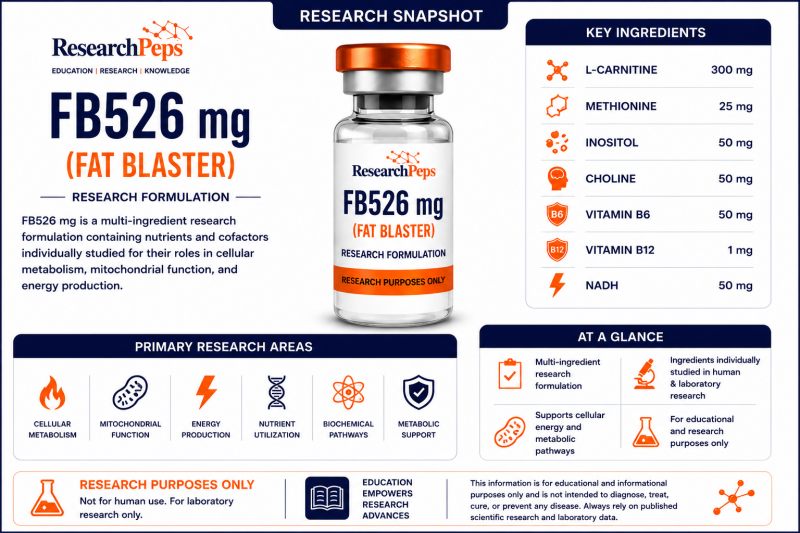
FB526 mg (Fat Blaster) is a multi-ingredient research formulation composed of compounds that have been individually studied for their roles in cellular metabolism, mitochondrial energy production, nutrient utilization, and biochemical pathways involved in normal metabolic function.
Unlike a single peptide, FB526 combines amino acids, vitamins, metabolic cofactors, and cellular nutrients into one investigational formulation. Researchers study these ingredients individually and in combination to better understand how they participate in cellular energy metabolism and mitochondrial biology.
The formulation contains:
- L-Carnitine – 300 mg
- Methionine – 25 mg
- Inositol – 50 mg
- Choline – 50 mg
- Vitamin B6 – 50 mg
- Vitamin B12 – 1 mg
- NADH – 50 mg
Current scientific interest focuses on how these nutrients contribute to normal cellular metabolism and energy-producing pathways.
Check it out here: https://researchpeps.org/product/lipo-c-fat-blaster/
Research Snapshot
Category Information
Research Name FB526 mg (Fat Blaster)
Classification Multi-Nutrient Research Formulation
Research Status Investigational Research Blend
Primary Research Areas Cellular Metabolism, Mitochondrial Function, Energy Production
Evidence Level Human & Preclinical Research
Primary Target Cellular Metabolism
At a Glance
What is FB526 mg?
A research formulation containing amino acids, vitamins, and metabolic cofactors investigated for cellular metabolism and energy production.
Why is it researched?
Researchers investigate the individual ingredients because of their involvement in mitochondrial biology, nutrient metabolism, and normal cellular function.
Current Evidence
Numerous published studies examine the individual ingredients across several areas of metabolism and cellular research.
Human Use
This article summarizes published scientific literature for educational purposes only.
How It Fits Within Cellular Biology
Each ingredient in FB526 participates in different biochemical pathways involved in normal cellular metabolism.
Researchers continue studying how these nutrients support mitochondrial function, energy production, and metabolic regulation.
Simplified Research Pathway
Primary Research Focus: Cellular energy production and mitochondrial metabolism.
What's Included in FB526 mg?
L-Carnitine (300 mg)
Researchers study L-Carnitine because of its role in transporting long-chain fatty acids into mitochondria where they can participate in normal energy-producing pathways.
Methionine (25 mg)
Methionine is an essential amino acid investigated for its role in methylation reactions, protein synthesis, and normal cellular metabolism.
Inositol (50 mg)
Researchers continue studying inositol because of its involvement in cellular signaling and membrane function.
Choline (50 mg)
Choline is investigated for its contribution to phospholipid synthesis, nervous system biology, and cellular membrane integrity.
Vitamin B6 (50 mg)
Vitamin B6 functions as a coenzyme in numerous metabolic reactions involving amino acids and energy metabolism.
Vitamin B12 (1 mg)
Researchers study Vitamin B12 because of its role in DNA synthesis, red blood cell biology, and mitochondrial energy pathways.
NADH (50 mg)
NADH is one of the body's primary electron carriers and is essential for normal mitochondrial ATP production.
Why Researchers Study FB526 mg
Scientists investigate the ingredients in FB526 because together they participate in multiple biological systems.
Current research interests include:
⚡ Cellular Energy
🔬 Mitochondrial Biology
🧬 Nutrient Metabolism
🧪 Cellular Function
❤️ Energy Production
🧫 Biochemical Pathways
Current Areas of Scientific Investigation
⚡ Mitochondrial Research
Scientists investigate how several ingredients contribute to normal mitochondrial energy production.
🔬 Cellular Metabolism
Published research explores metabolic pathways involved in nutrient utilization and ATP production.
🧬 Energy Biology
Researchers study how vitamins, amino acids, and cofactors contribute to normal energy metabolism.
🧪 Nutrient Utilization
Laboratory studies continue examining how these ingredients participate in cellular biochemical pathways.
❤️ Metabolic Function
Scientists investigate how normal metabolic regulation depends upon multiple nutrients working together.
How FB526 mg Works
Researchers generally describe the process as follows:
Nutrients
↓
Cellular Uptake
↓
Mitochondrial Metabolism
↓
ATP Production
↓
Cellular Energy
↓
Metabolic Research
Scientists continue investigating these pathways to better understand cellular physiology.
Why FB526 mg Is Unique
Unlike individual research peptides, FB526 combines several nutrients that participate in different aspects of cellular metabolism.
Researchers investigate the formulation because each ingredient contributes to normal biochemical pathways involved in energy production and mitochondrial function.
Quick Facts
✔ Multi-ingredient research formulation
✔ Includes L-Carnitine and NADH
✔ Studied in cellular metabolism
✔ Human and laboratory research available on individual ingredients
✔ Research continues expanding
Important Scientific Considerations
FB526 contains several well-studied nutrients with established biological roles. Current scientific investigations continue exploring how these ingredients contribute individually and collectively to cellular metabolism, mitochondrial biology, and energy production.
Research continues to evolve as additional studies become available.
Key Takeaways
✔ FB526 mg is a multi-nutrient investigational formulation.
✔ Researchers study cellular metabolism and mitochondrial function.
✔ Individual ingredients have extensive published scientific literature.
✔ Human and laboratory studies continue expanding scientific understanding.
✔ Additional research remains ongoing.
Continue Exploring Related Research
Related Cellular & Mitochondrial Research
Learn about one of the body's most important cellular energy molecules.
➡️ L-Carnitine + B12 Research Guide
Explore research involving mitochondrial metabolism and nutrient transport.
Research involving mitochondrial signaling peptides.
Cellular antioxidant biology and oxidative stress research.
Research involving mitochondrial function and cellular bioenergetics.
Further Reading
The publications below represent foundational scientific literature related to the ingredients found in FB526 mg.
Selected References
Cellular Metabolism
1. Flanagan JL, et al. (2010). Role of carnitine in disease. Nutrition & Metabolism.
2. Rebouche CJ. (2004). Kinetics, pharmacokinetics, and regulation of L-carnitine metabolism. Annals of the New York Academy of Sciences.
NADH & Energy Biology
3. Pollak N, et al. (2007). The power to reduce: Pyridine nucleotides—small molecules with a multitude of functions. Biochemical Journal.
4. Ying W. (2008). NAD+/NADH and cellular metabolism. Antioxidants & Redox Signaling.
Vitamins & Nutrient Metabolism
5. Zeisel SH. (2006). Choline: Critical role during development and metabolism. Annual Review of Nutrition.
6. O'Leary F, Samman S. (2010). Vitamin B12 in health and disease. Nutrients.
Educational Notice
The information presented in this article is intended solely for educational and informational purposes regarding published scientific research.
FB526 mg is an investigational research formulation composed of multiple nutrients and metabolic cofactors. References to laboratory, preclinical, and human studies summarize current scientific knowledge regarding the individual ingredients and should not be interpreted as evidence of safety or effectiveness for any specific use.
This content is not medical advice and should not be used to diagnose, treat, cure, or prevent any disease.
]