

Preventing Contamination in Research Samples
Understanding Good Laboratory Practices During Sample Preparation and Handling
Article Details
🕒 Estimated Reading Time: 8–10 minutes
📅 Last Reviewed: August 2026
📚 Research Category: Research Fundamentals
🔬 Topic: Laboratory Practices & Sample Integrity
📖 Article Type: Educational Guide
Introduction
Whether researchers are preparing reagents, handling laboratory samples, or conducting analytical testing, contamination is one of the most common causes of compromised research materials.
Many contaminants are invisible to the naked eye. Dust particles, bacteria, fungi, and residues from previously handled materials can all affect laboratory samples if good handling practices are not followed.
While laboratories use validated protocols designed to reduce contamination, understanding the basic principles of sample handling helps explain why careful technique is considered an essential part of scientific research.
Why Contamination Matters
Research depends on reliable and consistent samples.
If unwanted contaminants are introduced during handling, they may:
🦠 Introduce microorganisms into the sample
🧪 Alter laboratory test results
📊 Reduce experimental consistency
⚗️ Affect analytical measurements
🔬 Interfere with research reproducibility
Because of these possibilities, laboratories place a strong emphasis on maintaining sample integrity throughout the research process.
Research Snapshot
Category Information
Topic Sample Contamination Prevention
Primary Goal Maintain Sample Integrity
Common Risks Microorganisms, Dust, Cross-Contamination
Research Focus Laboratory Handling Practices
Importance Quality Control & Reliable Research
At a Glance
What is contamination?
The introduction of unwanted microorganisms, particles, chemicals, or residues into a research sample.
Why is prevention important?
Proper handling helps preserve sample integrity and supports reliable laboratory research.
Can contamination always be seen?
No. Many forms of contamination are microscopic and cannot be detected by visual inspection alone.
Common Sources of Contamination
Researchers recognize several potential sources of contamination during laboratory work.
These may include:
🦠 Airborne bacteria and fungi
🌬️ Dust and environmental particles
👐 Skin contact
🧪 Previously used laboratory equipment
💧 Contaminated solutions or reagents
🔄 Cross-contact between different samples
Because many contaminants are microscopic, good laboratory practices are designed to reduce exposure whenever possible.
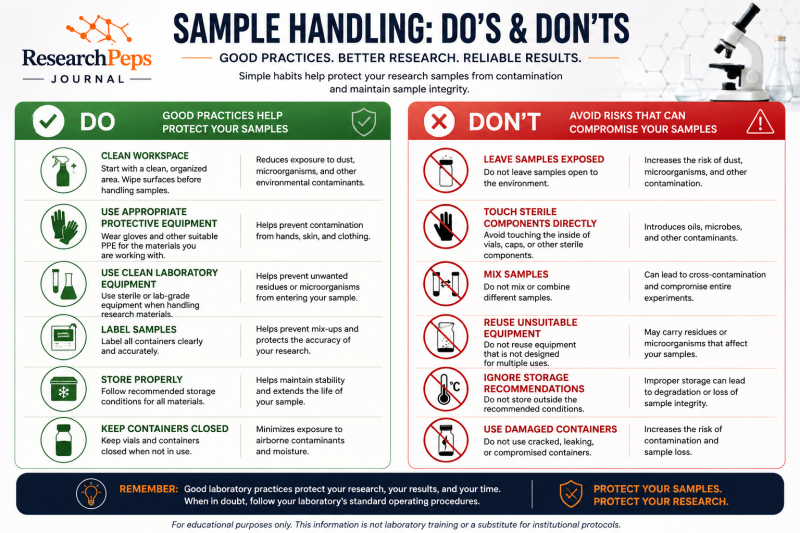
Good Laboratory Practices (Do's)
The following practices are commonly emphasized in research laboratories to help maintain sample integrity.
✔ Work in a Clean Environment
Preparing samples in a clean workspace helps reduce exposure to dust and other environmental contaminants.
✔ Use Appropriate Laboratory Equipment
Researchers use clean, laboratory-grade equipment suitable for the materials being handled.
✔ Handle Samples Carefully
Minimizing unnecessary handling reduces opportunities for accidental contamination.
✔ Keep Containers Closed When Not in Use
Limiting exposure to the surrounding environment helps maintain sample integrity.
✔ Label Samples Clearly
Proper labeling helps prevent confusion and accidental mix-ups between research materials.
✔ Store Samples Properly
Following recommended laboratory storage conditions helps preserve sample stability throughout the course of a study.
Practices That Increase Contamination Risk (Don'ts)
Researchers generally avoid practices that may increase the likelihood of contamination.
Examples include:
❌ Working in cluttered or dirty environments
❌ Allowing samples to remain exposed longer than necessary
❌ Using damaged or unsuitable laboratory equipment
❌ Touching sterile components with bare hands
❌ Mixing or confusing research samples
❌ Improper storage after preparation
Avoiding these situations helps reduce contamination risk and supports consistent laboratory results.
What Can Happen If a Sample Becomes Contaminated?
The effects depend on the type and extent of the contamination, but potential consequences in a research setting may include:
🦠 Microbial Growth
Microorganisms introduced into a sample may multiply under suitable conditions, potentially altering the material over time.
⚗️ Chemical Changes
Some contaminants may interact with the sample and affect its composition or analytical results.
📉 Reduced Experimental Reliability
Contamination can introduce unexpected variables that make research findings more difficult to interpret or reproduce.
🧪 Inaccurate Laboratory Measurements
Analytical techniques such as HPLC or Mass Spectrometry may detect unexpected components if contamination is present.
🚫 Loss of Sample Integrity
In some situations, contamination may make a research sample unsuitable for its intended laboratory purpose.
Can Contamination Always Be Seen?
No.
Many contaminants are microscopic.
A sample may appear visually unchanged while still containing microorganisms or trace contaminants that can affect laboratory work.
Because visual inspection alone cannot confirm cleanliness, research laboratories rely on validated handling procedures rather than appearance.
Why Researchers Use Sterile Technique
Good laboratory practice emphasizes reducing contamination risk throughout the entire handling process.
Sterile (aseptic) technique helps researchers:
✔ Protect sensitive samples
✔ Reduce contamination opportunities
✔ Improve consistency
✔ Support reliable experimental results
It is one of the fundamental principles of laboratory science.
Key Takeaways
✔ Contamination can affect research quality even when it is not visible.
✔ Clean workspaces and careful handling help maintain sample integrity.
✔ Proper storage and appropriate laboratory equipment support consistent results.
✔ Sterile technique is an important part of good laboratory practice.
✔ Preventing contamination helps improve the reliability and reproducibility of scientific research.
Continue Exploring Related Articles
Learn about aseptic laboratory practices and why they are important.
Discover how laboratories evaluate sample purity.
Learn how scientists confirm compound identity.
➡️ Understanding Certificates of Analysis (COAs)
Explore how laboratory testing results are documented.
➡️ Understanding Lyophilization
Learn how freeze-drying helps preserve research materials.
Further Reading
Laboratory Practices
1. World Health Organization. Laboratory Biosafety Manual. 4th Edition.
2. Centers for Disease Control and Prevention (CDC). Biosafety in Microbiological and Biomedical Laboratories (BMBL). 6th Edition.
Good Laboratory Practice
3. OECD. Principles of Good Laboratory Practice (GLP).
4. United States Pharmacopeia (USP). General chapters on aseptic practices and laboratory quality.
Sample Integrity
5. U.S. Food and Drug Administration (FDA). Guidance on laboratory quality systems.
6. National Institute of Standards and Technology (NIST). Resources on analytical quality assurance.
Educational Notice
The information presented in this article is intended solely for educational and informational purposes regarding laboratory science.
This guide discusses general laboratory practices used to help maintain sample integrity and reduce contamination risk. It is not a substitute for laboratory training, institutional protocols, or validated standard operating procedures.