

🔬 Research Spotlight:
KPV: How Three Amino Acids Influenced Inflammatory Signaling in Laboratory Studies
ResearchPeps Journal | Scientific Research & Education
Updated October 17 2026
Can a Compound Made of Just Three Amino Acids Influence Complex Biological Pathways?
Sometimes the most interesting scientific discoveries involve surprisingly small molecules.
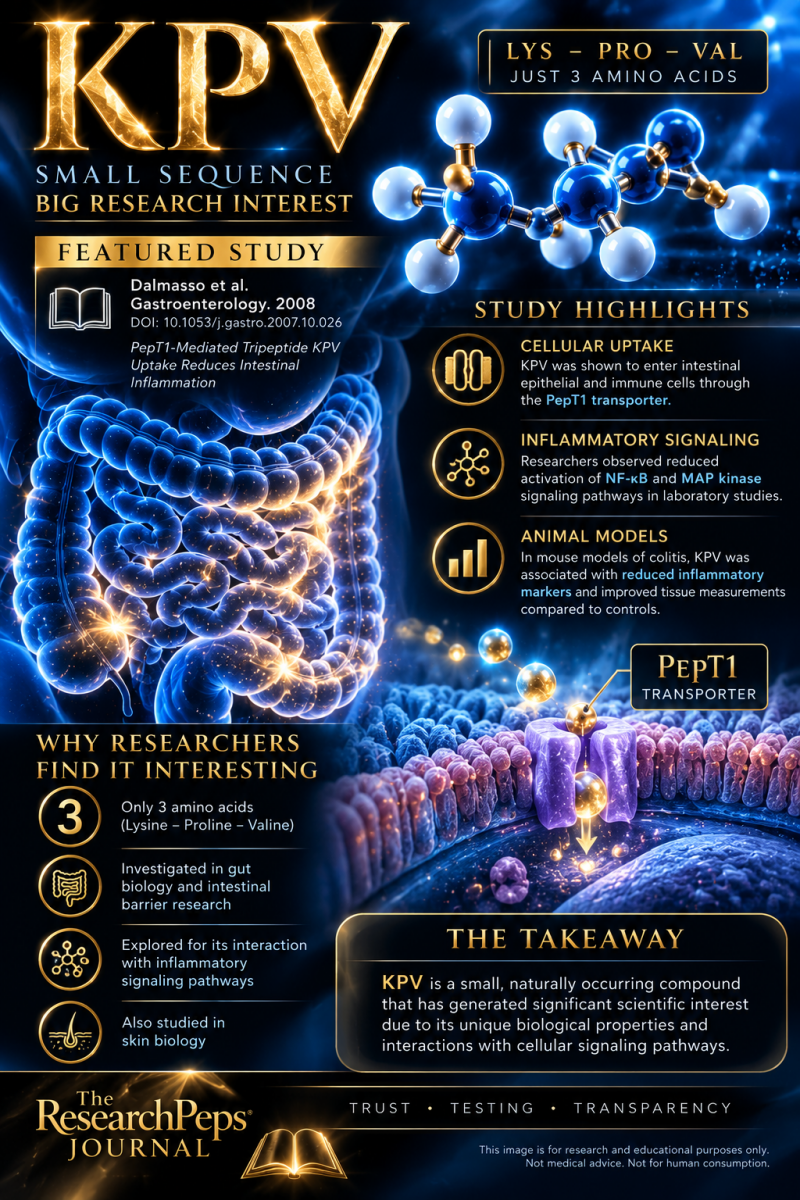
KPV, a naturally occurring three-amino-acid sequence consisting of Lysine–Proline–Valine, has attracted scientific interest because of its behavior in experimental models of inflammation.
One particularly interesting study, published in Gastroenterology in 2008, investigated how KPV enters intestinal cells and influences inflammatory signaling.
The researchers explored a fascinating question: Could a cellular transporter help deliver KPV into cells involved in intestinal inflammation?
The Study
Title: PepT1-Mediated Tripeptide KPV Uptake Reduces Intestinal Inflammation
Authors: Dalmasso G. et al.
Journal: Gastroenterology, 2008;134(1):166–178
DOI: 10.1053/j.gastro.2007.10.026
Study type: Preclinical laboratory and animal research
What Were Researchers Investigating?
Researchers examined the relationship between KPV and PepT1, a cellular transporter that normally helps move small peptides into intestinal cells.
The study investigated whether PepT1 could transport KPV into intestinal epithelial and immune cells and whether that process influenced inflammatory responses.
Scientists used cultured human-derived cells and two experimentally induced mouse models of colitis.
Three Important Findings
1. KPV Entered Cells Through PepT1
Researchers demonstrated that PepT1 played an important role in transporting KPV into the studied intestinal epithelial and immune cells.
This was significant because it helped explain how a small molecule could reach intracellular signaling pathways.
2. Changes in Inflammatory Signaling Were Observed
In laboratory experiments, KPV reduced activation of NF-κB and MAP kinase signaling pathways.
These pathways participate in cellular responses to inflammatory stimuli.
Researchers also observed reduced secretion of certain inflammatory signaling molecules.
3. Reduced Inflammatory Markers in Mouse Models
In two mouse models of experimentally induced colitis, KPV administration was associated with reduced inflammatory responses.
In one model, researchers reported approximately a 50% reduction in colonic myeloperoxidase activity, a laboratory marker associated with inflammatory cell activity, compared with mice exposed to the inflammatory stimulus alone.
Additional findings included improvements in certain tissue measurements and reduced expression of inflammatory signaling molecules.
Why Is This Scientifically Interesting?
KPV consists of only three amino acids, yet this study demonstrated measurable biological activity in experimental systems.
The research also highlighted the importance of cellular transporters.
Rather than studying only what a molecule does, researchers investigated how it enters cells and which pathways may be affected afterward.
This distinction is important when scientists investigate the relationship between molecular structure, cellular transport, and biological activity.
What Does This Study NOT Establish?
Although the experimental findings were promising, the study did not demonstrate that KPV safely or effectively treats inflammatory bowel disease or other conditions in humans.
The experiments involved cultured cells and animal models. Results from these systems cannot automatically be applied to people.
Additional human clinical research would be necessary to establish safety, effectiveness, appropriate formulations, and clinical relevance.
The Bigger Scientific Question
The study raises an interesting possibility for future investigation:
Could understanding small-molecule transport systems help researchers develop more targeted approaches to studying inflammatory pathways?
That question remains an important scientific topic.
ResearchPeps Journal Takeaway
KPV illustrates why researchers investigate even the smallest biological compounds.
With only three amino acids, KPV provides an interesting model for studying cellular transport, inflammatory signaling, and the relationship between molecular structure and biological activity.
The findings are scientifically interesting, but the distinction between preclinical research and proven human benefits remains essential.
Original Scientific Publication
Dalmasso G, Charrier-Hisamuddin L, Nguyen HTT, Yan Y, Sitaraman S, Merlin D. PepT1-mediated tripeptide KPV uptake reduces intestinal inflammation. Gastroenterology. 2008;134(1):166–178.
DOI: https://doi.org/10.1053/j.gastro.2007.10.026
Full research article: https://pmc.ncbi.nlm.nih.gov/articles/PMC2431115/
ResearchPeps® — Trust • Testing • Transparency
Educational Disclaimer: This article summarizes published scientific research for informational and educational purposes only. The findings discussed are primarily preclinical and do not establish safety or efficacy in humans. Nothing in this article constitutes medical advice, a treatment recommendation, or an endorsement of human consumption. ResearchPeps products are intended strictly for research and educational purposes and are not for human consumption.
The ResearchPeps Journal
Independent Educational Research & Scientific Information
The ResearchPeps Journal provides educational information about research compounds, peptides, laboratory testing, cellular biology, metabolism, mitochondrial science, and emerging scientific research.
Looking for ResearchPeps?
Visit ResearchPeps.org to learn more about ResearchPeps and view its available research products.
ResearchPeps Website:
https://researchpeps.org
Educational & Research Disclaimer
Content provided by The ResearchPeps Journal is for educational and informational purposes only. Information presented on this website is intended to discuss scientific literature, laboratory research, research compounds, and related scientific concepts.
Content should not be interpreted as medical advice, diagnosis, treatment guidance, or a recommendation for human use. Discussion of a compound or research finding does not establish its safety, effectiveness, or suitability for any particular purpose.
Research compounds discussed within the Journal may be investigational and may not be approved by the U.S. Food and Drug Administration (FDA) for human use.
Always refer to the original scientific publication when evaluating research findings.