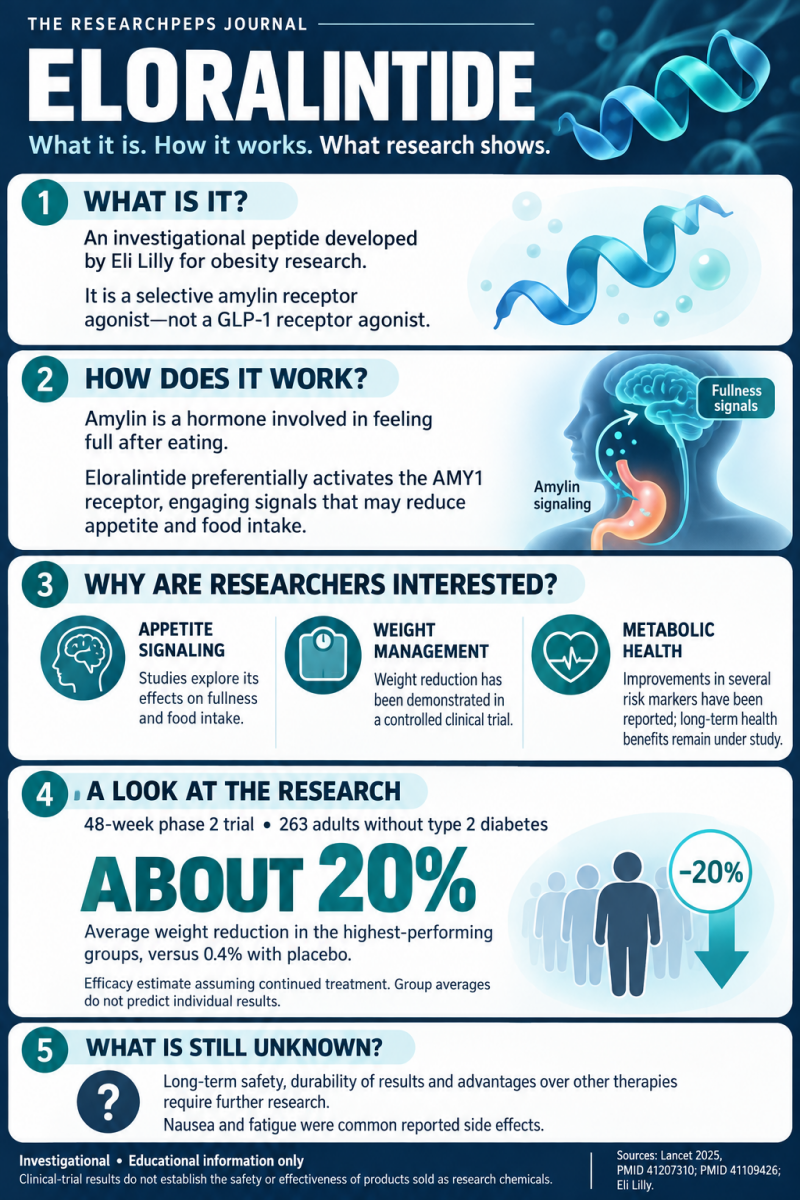
WHAT IS ELORALINTIDE?
Eloralintide and the Science of Amylin Signaling
The ResearchPeps Journal | Research overview | October 29, 2026
Eloralintide is attracting interest because it explores a different pathway in appetite research: amylin. Although GLP-1 medicines have received much of the attention, they are not the only compounds being studied for weight management. Eloralintide has produced meaningful weight reductions in a controlled clinical trial, but questions about long-term safety and its advantages over other approaches remain unanswered.
What is eloralintide?
Eloralintide, previously known as LY3841136, is an investigational peptide developed by Eli Lilly. It belongs to a group called selective amylin receptor agonists. An agonist activates a receptor—the cellular structure that receives a biological signal. Eloralintide preferentially activates the amylin 1 receptor, usually shortened to AMY1. [1, 2]
It is not a GLP-1 receptor agonist. Its main research target is amylin signaling, which makes it distinct from semaglutide and from the GIP/GLP-1 activity of tirzepatide. As of this overview, Lilly describes eloralintide as investigational and reports ongoing phase 3 studies. [3]
What does amylin do?
Amylin is a naturally occurring hormone involved in the body's response to eating. It contributes to satiety—the feeling of fullness—and helps regulate appetite and food intake. Researchers are investigating whether activating its receptors can strengthen signals that influence how much a person eats. [3, 4]
Eloralintide is designed to act on this signaling system. Describing it simply as a “fat burner” misses the mechanism being studied: its potential to influence appetite and food intake through receptor activation. [2, 4]
What have clinical trials shown?
A phase 2 trial published in The Lancet enrolled 263 adults with obesity, or overweight with a weight-related condition, who did not have type 2 diabetes. Participants received eloralintide or placebo over 48 weeks. [1]
In the highest-performing groups, average body weight fell by approximately 20%, compared with 0.4% in the placebo group. These results used an efficacy estimand: an analysis estimating outcomes if participants remained on study treatment. They are group averages under study conditions, not a promise of individual results. [1, 4]
Lilly also reported improvements in waist circumference, blood pressure, lipid profiles and measures of glycemic control. These findings warrant further investigation; changes in risk markers do not by themselves establish that a treatment prevents heart attacks, strokes or other long-term complications. [4]
Why does receptor selectivity matter?
Different receptors can contribute to different biological effects. Eloralintide was designed to favor AMY1 over certain related receptors. Laboratory testing found stronger activity at human AMY1 than at AMY3 or the calcitonin receptor. [2]
This selectivity gives researchers a way to investigate whether receptor targeting can influence both effectiveness and tolerability. However, “more selective” does not automatically mean safer, stronger or better. Laboratory findings must be tested against outcomes in people. [2]
How does it compare with cagrilintide?
Cagrilintide, sometimes called “Cag,” is another investigational amylin-based compound. Both compounds are being studied for weight management, but they have different receptor activity profiles. Eloralintide favors AMY1, while cagrilintide has broader activity across amylin and calcitonin receptors. [2]
That difference does not establish a clinical winner. The sources discussed here do not provide a direct human trial comparing eloralintide with cagrilintide. Comparing percentages from separate studies cannot settle the question because study duration, participants, treatment regimens and analysis methods can differ.
What about side effects?
In the 48-week phase 2 trial, nausea and fatigue were the most common adverse events reported with eloralintide. Their frequency varied substantially between treatment groups. Selective receptor activity therefore should not be interpreted as an absence of side effects. [1]
Larger and longer studies are needed to better characterize uncommon risks, sustained outcomes and which patients might benefit most. The trial was funded by Lilly, a relevant consideration when assessing the evidence alongside future independent research. [1]
Why study it with tirzepatide?
Eloralintide and tirzepatide act through different receptor systems. Researchers are studying their combination, called EloraTZP, to investigate the effects of engaging amylin, GIP and GLP-1 pathways together. Lilly reported phase 2b combination findings in September 2026. [3]
Results from a combination cannot be attributed to eloralintide alone. Combination studies also do not establish that independently sourced compounds can be safely mixed or used together outside a clinical trial.
Eloralintide's importance lies in the questions it can help answer about appetite biology and receptor selectivity. The existing findings support continued investigation, while direct comparisons and longer follow-up will be essential for understanding its eventual place in treatment.
This article is an educational overview, not original research or medical advice. It does not provide dosing, preparation or administration guidance. Clinical-trial findings do not establish the safety, purity or effectiveness of products sold as research chemicals.
Sources
-
Billings LK and colleagues. Eloralintide phase 2 randomized trial. The Lancet, 2025. https://pubmed.ncbi.nlm.nih.gov/41207310/
-
Briere DA and colleagues. Eloralintide from discovery to clinical proof of concept. Molecular Metabolism, 2025. https://pubmed.ncbi.nlm.nih.gov/41109426/
-
Eli Lilly. What to know about eloralintide. Developer overview, accessed October 29, 2026. https://www.lilly.com/news/stories/what-to-know-about-eloralintide
-
Eli Lilly. Phase 2 eloralintide results, November 6, 2025. Developer announcement. https://investor.lilly.com/news-releases/news-release-details/lillys-selective-amylin-agonist-eloralintide-demonstrated
Website excerpt: Explore what eloralintide is, how amylin signaling affects appetite, what clinical trials have found and how it differs from cagrilintide.
Suggested URL slug: eloralintide-amylin-research
Header image alt text: Eloralintide article header with abstract teal and violet peptide ribbons and the words “The science behind a different approach to appetite.”
Image caption: Conceptual illustration of peptide signaling; not a molecular structure diagram.