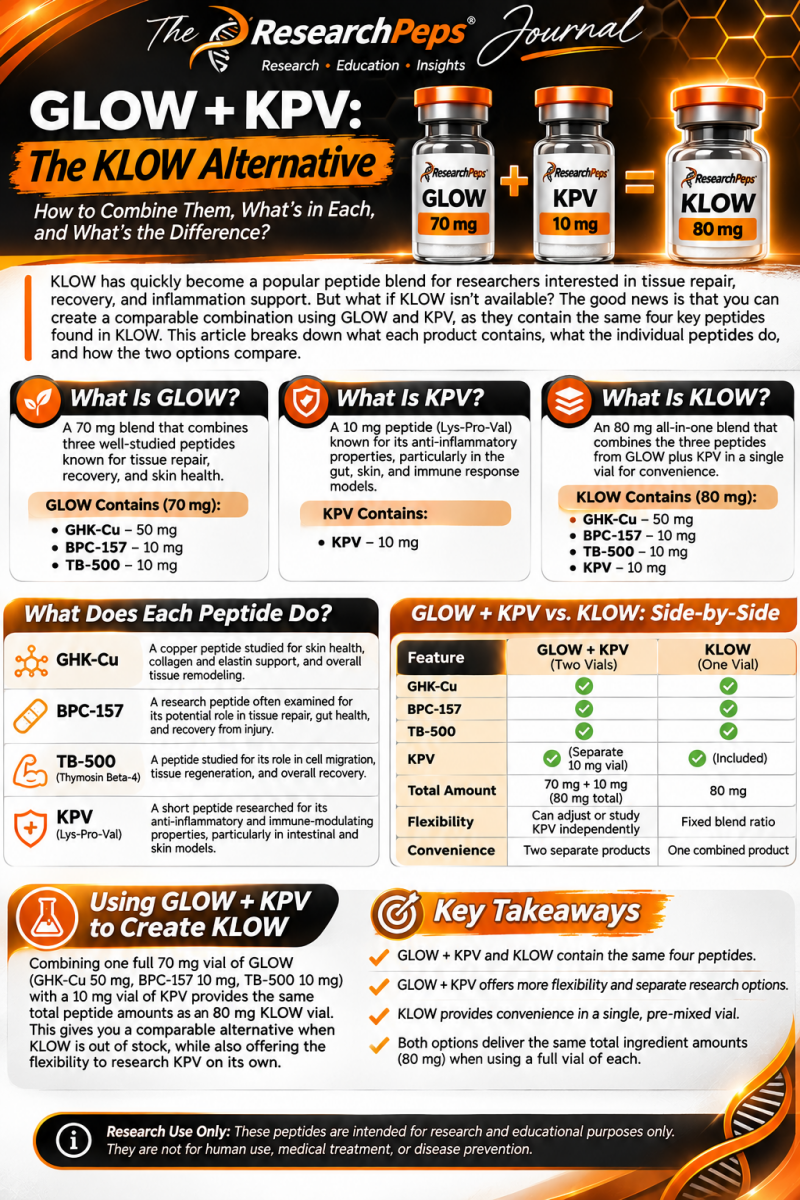
GLOW + KPV vs. KLOW:
Can Two Research Peptide Formulations Recreate One Blend?
Understanding the ingredients, research applications, and key differences between GLOW, KPV, and KLOW.
In the world of peptide research, combination formulations continue to attract attention for their potential to support investigations into cellular signaling, inflammation, skin biology, and tissue repair.
Two formulations frequently discussed are GLOW and KLOW. Although their names are similar, there is one important difference: GLOW typically contains three peptides, while KLOW combines four.
But what happens when researchers investigate GLOW alongside KPV? Can the two separate formulations reproduce the ingredients found in KLOW?
Let's explore what each contains, what the individual peptides are being studied for, and how these formulations compare.
What Is GLOW?
GLOW is a research peptide blend typically containing three compounds:
-
GHK-Cu — 50 mg
-
BPC-157 — 10 mg
-
TB-500 — 10 mg
Total: 70 mg
Each peptide has a different research background, making GLOW an interesting combination for studying multiple cellular pathways.
GHK-Cu: Skin Biology and Cellular Repair
GHK-Cu is a naturally occurring copper-binding peptide that has attracted scientific interest for its involvement in skin biology and extracellular matrix regulation.
Researchers have investigated GHK-Cu for:
-
Collagen and elastin regulation
-
Skin remodeling and wound-healing pathways
-
Cellular responses to oxidative stress
-
Inflammatory signaling
-
Hair follicle biology
Much of the evidence comes from laboratory, animal, and limited human cosmetic research. Results should not be interpreted as proof that injectable peptide blends produce the same effects.
BPC-157: Tissue Repair Research
BPC-157 is a synthetic peptide studied primarily in preclinical models involving tissue injury and repair.
Research areas include:
-
Tendon and ligament injury models
-
Gastrointestinal tissue responses
-
Angiogenesis-related signaling
-
Inflammatory pathways
-
Cellular responses following tissue damage
Although animal studies have generated interest, high-quality human clinical evidence remains extremely limited.
TB-500: Cell Migration and Tissue Remodeling
TB-500 is commonly marketed as a peptide related to thymosin beta-4, a naturally occurring protein involved in cellular processes.
Research involving thymosin beta-4 has examined:
-
Cell migration
-
Actin regulation
-
Tissue remodeling
-
Wound-healing pathways
-
Inflammatory responses
An important distinction is that commercial TB-500 formulations may not be identical to full-length thymosin beta-4 used in published studies. Their identities should be verified before applying research findings to a particular product.
What Is KPV?
KPV is a short peptide consisting of three amino acids:
Lysine – Proline – Valine
It corresponds to the final three amino acids of alpha-melanocyte-stimulating hormone (α-MSH).
KPV has attracted research attention primarily because of its potential involvement in inflammatory signaling.
What Is KPV Being Studied For?
1. Gut and intestinal inflammation
Preclinical studies have examined KPV in models of intestinal inflammation, including pathways associated with inflammatory bowel conditions.
2. Skin inflammation
KPV has also been investigated for its potential effects on inflammatory responses involving skin cells.
3. Immune signaling
Laboratory research has explored KPV's interaction with pathways such as NF-κB and the production of inflammatory mediators.
4. Cellular inflammatory responses
Researchers are investigating whether KPV influences how cells respond to inflammatory stimuli.
These findings are preliminary. KPV is not an established treatment for inflammatory bowel disease, skin disorders, or other medical conditions.
What Is KLOW?
KLOW is a four-peptide research blend that typically contains:
-
GHK-Cu — 50 mg
-
BPC-157 — 10 mg
-
TB-500 — 10 mg
-
KPV — 10 mg
Total: 80 mg
KLOW brings together the three peptides associated with GLOW and adds KPV as a fourth component.
The addition of KPV expands the formulation's research focus to include inflammatory signaling pathways associated with KPV.
However, the presence of an additional peptide does not establish that KLOW is more effective than GLOW.
Can GLOW + KPV Recreate KLOW?
From an ingredient-quantity perspective, yes—provided the formulations match the stated compositions.
A 70 mg GLOW vial containing 50 mg GHK-Cu, 10 mg BPC-157, and 10 mg TB-500, together with a separate 10 mg KPV vial, represents the same nominal peptide quantities as an 80 mg KLOW formulation containing those four ingredients.
However, this is an ingredient comparison—not a validated preparation method.
Combining peptides physically may introduce questions about chemical compatibility, solubility, degradation, aggregation, sterility, and stability. Without formulation-specific testing, the resulting preparation cannot be assumed equivalent to a manufactured KLOW blend.
What Are the Advantages of Studying GLOW and KPV Separately?
One of the biggest distinctions is experimental flexibility.
When GLOW and KPV are maintained as separate research materials, researchers can design studies examining the three-peptide blend, KPV alone, and their respective biological pathways.
This may make it easier to investigate the individual contribution of KPV without automatically including it in every experimental condition.
Separate materials also allow researchers to evaluate storage stability and analytical characteristics independently.
However, separate products do not inherently provide greater purity, stability, or safety. Those characteristics depend on manufacturing quality, handling, and analytical verification.
What Are the Advantages of KLOW?
The primary distinction of KLOW is convenience.
KLOW contains all four peptides in a single premixed formulation with predetermined proportions.
For research protocols specifically designed to investigate that combination, a single formulation may simplify product identification and experimental planning.
However, KLOW does not allow KPV to be independently adjusted without changing the relationship between the other components.
A premixed formulation also requires its own compatibility and stability data.
Is KLOW Better Than GLOW + KPV?
At present, there is insufficient clinical evidence to conclude that one approach is better.
Although the individual peptides have attracted scientific interest, research into their combined effects remains limited.
Questions still requiring investigation include:
-
Whether the four peptides interact chemically or biologically
-
Whether combining them changes their stability
-
Whether KPV alters the activity of the three-peptide GLOW formulation
-
Whether premixed and separate formulations behave differently in experimental models
-
Whether the combinations have any established safety or efficacy in humans
Matching ingredient quantities alone cannot answer these questions.
Final Thoughts: Same Ingredients, Different Research Flexibility
The biggest takeaway is simple:
GLOW + KPV and KLOW can contain the same four peptides in the same nominal amounts, but they are not automatically interchangeable formulations.
GLOW contains GHK-Cu, BPC-157, and TB-500. KPV introduces a separate research focus involving inflammatory signaling. KLOW brings all four together in one blend.
For researchers, the decision between separate compounds and a premixed formulation depends on experimental objectives, analytical documentation, and the evidence available for the specific materials.
As peptide research continues to evolve, understanding the differences between ingredient composition and proven biological equivalence remains essential.
Research Disclaimer
This article is provided for educational and scientific research discussion only. It is not medical advice or an instruction to prepare, mix, administer, or use peptide products. These research peptides and combinations have not been established as safe or effective for human use. Research materials should be handled only by appropriately qualified personnel under suitable laboratory procedures.
The ResearchPeps Journal — Exploring the Science Behind the Research.